20 Traditional Indian Folk Art Forms: History, Motifs, and Cultural Significance
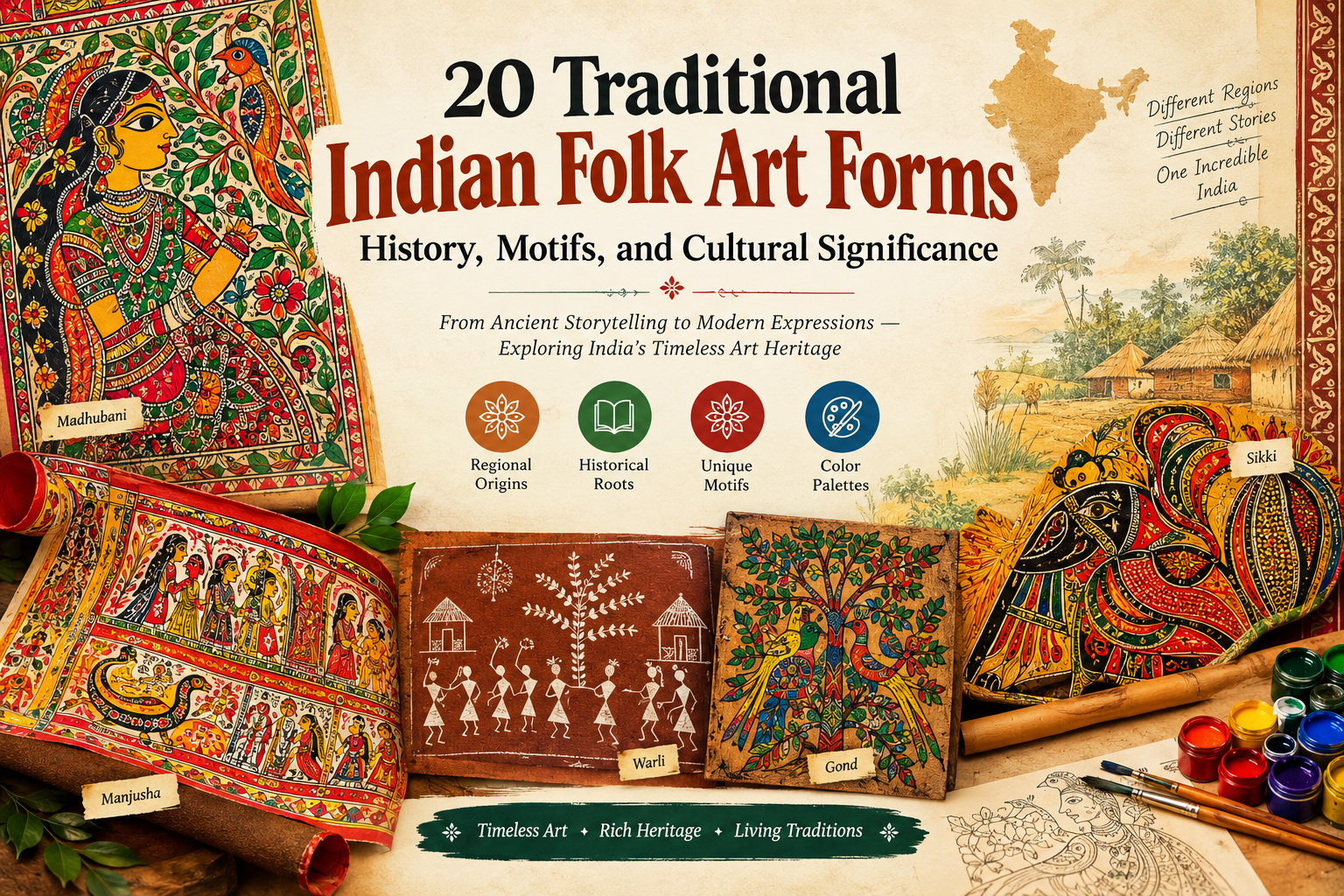
Indian folk art is not a single artistic language. Across villages, tribal communities, temple towns, river valleys, forests and old trading centres, artists have developed distinctive ways of recording stories, rituals, beliefs, nature and everyday life. Some traditions were created on mud walls before festivals, some were painted on cloth for religious storytelling, some took the form of scrolls accompanied by songs, while others evolved as sacred textiles, baskets, cards and ceremonial objects.This guide explores 20 traditional Indian folk art and heritage art forms, with a focus on their regional origins, historical roots, visual vocabulary, characteristic motifs, colour palettes, cultural significance and modern adaptations.One of the most fascinating features of Indian traditional art is that the picture itself can function as a cultural archive. A painted snake, a lotus, a sun, a boat, a dancing circle, a goddess or an animal may carry meanings that go far beyond decoration. In narrative traditions such as Manjusha, Madhubani, Pattachitra, Bengal Patachitra, Phad and Cheriyal, visual imagery can preserve stories that were also transmitted through oral traditions.
At the same time, these art forms are not frozen in the past. Many have moved from mud walls and ceremonial objects to handmade paper, canvas, textiles, furniture, home décor, stationery, fashion products and contemporary visual media. That transition can help living traditions reach new audiences, provided that the identity, community knowledge and cultural context of the original art are respected.
1. Madhubani Painting: The Visual Language of Mithila
Madhubani painting, also widely known as Mithila painting, comes from the Mithila region of Bihar and adjoining cultural areas. Traditionally associated with women of the region, it was painted on freshly plastered mud walls and floors during weddings, festivals and religious occasions. Today it is widely practiced on paper, cloth and canvas.
The historical narrative of Madhubani is often connected in popular tradition to the wedding of Sita and Rama in the Ramayana. That story is a cultural origin legend rather than a simple archaeological dating statement. What is better documented is the long-standing ritual use of Mithila wall painting and its continued transmission through generations.
Madhubani’s visual identity is built around strong outlines, rhythmic patterning and dense filling of available space. Depending on style and artist, forms may be rendered through linear kachni treatment, bold colour-filled bharni areas, geometric elements and other local conventions.
Common motifs include lotus flowers, fish, peacocks, birds, trees, the sun, moon, sacred plants, geometric borders and Hindu deities. Themes range from Ramayana and Krishna stories to weddings, fertility, social life and nature.
The palette is generally bright and highly contrasting, with colours such as red, yellow, green, blue, black and white appearing in different styles. Traditional pigments could be prepared from plant, mineral and household sources. A notable feature is the use of patterned filling and limited shading rather than Western-style modelling.
Modern Madhubani has expanded into wall art, apparel, notebooks, stationery, home décor and digital reproduction, allowing the style to move far beyond its original architectural setting. Government of Bihar and official GI documentation also recognize its regional identity and longstanding craft heritage.
Recommended Madhubani Art
PAPER PLANE DESIGN Madhubani paintings for living room – Set of 3 canvas wrapped framed Madhubani art for wall decor
2. Manjusha Art: The Story Scroll Tradition of Ang Region
Manjusha Art is a distinctive folk tradition associated with Bhagalpur and the wider Ang region of Bihar. Its defining cultural narrative is the Bihula–Bishari folklore, a regional story involving Bihula, Bishari or Mansa, the merchant Chandu/Chand Saudagar, Bala and the serpent world.
The name is linked to the manjusha, a temple-shaped ritual box traditionally made from materials such as bamboo, jute and paper. These objects were not simply decorative containers. Their painted surfaces carried episodes and characters connected with the local religious tradition of Bishari worship.
One of the most important features of Manjusha is its sequential storytelling structure. Instead of presenting a single isolated image, the artwork can be arranged as a series of visual episodes that together communicate a larger narrative. Bihar Museum specifically highlights this panel-by-panel narrative character.
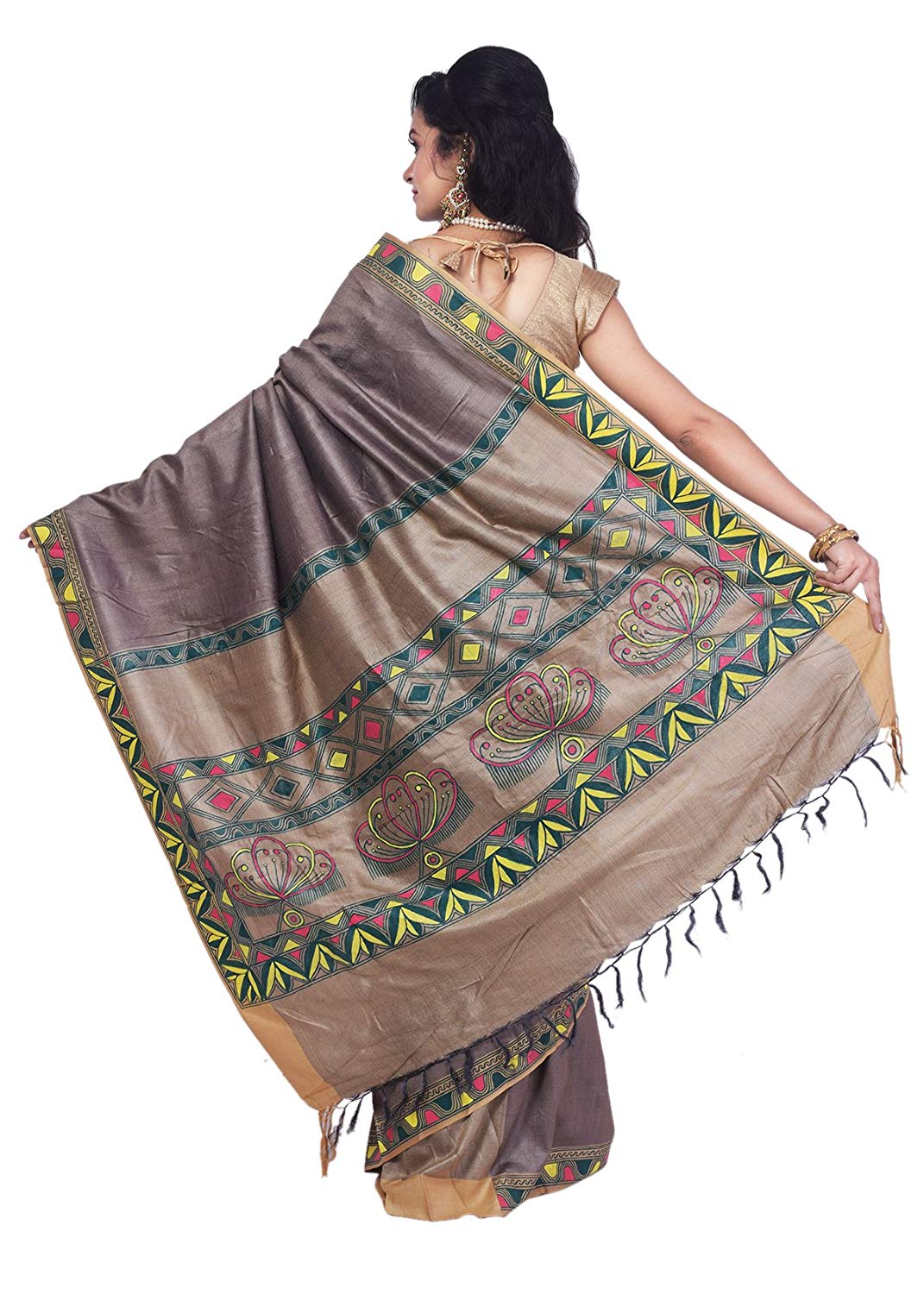
The classic Manjusha palette is unusually restricted: pink, green and yellow, commonly worked with bold black outlining on a light background. Repeated motifs include snakes, flowers, birds, sun, moon, animals and stylised human figures. The characteristic angular or X-like human posture is one of its most recognisable features.
The tradition was once at risk of decline, but revival efforts, artist training and new markets have helped it move onto paper, canvas, fabric, pots, wall décor and other products. Contemporary practice may use modern paints and expanded shades, but the strongest identity of the form remains its narrative structure and restricted visual vocabulary.
Official sources from Bihar and the Ministry of Textiles associate Manjusha with the Bihula–Bishari tradition and its three-colour line-drawing system. Recent government cultural initiatives have also used Manjusha for workshops, murals and cultural presentation.
Recommended Manjusha Art
Manjusha Art: Heritage of Ang Region
Manjusha art representing the heritage of Ang region.
3. Sikki Grass Craft: Golden Fibre Heritage of Bihar
Sikki is a traditional grass craft of Bihar rather than a painting tradition, but it belongs naturally in any discussion of Indian folk and heritage arts. Sikki grass is known for its natural golden sheen and is woven into baskets, containers, boxes, decorative figures and utility objects.
The craft has historically been embedded in domestic life, festive use and ritual contexts in parts of Bihar. Because objects were generally made for household use rather than for an external commercial market, documenting the earliest history of Sikki is difficult.
The process demonstrates the close relationship between craft and local ecology. Sikki is harvested, washed and dried before being prepared for weaving. The delicate golden grass is often used over a stronger structural base made from other local fibres such as moonj.
Traditional Sikki objects display coiling, braiding, wrapping and tightly controlled geometric construction. Natural golden yellow is the visual signature, but dyed strands can introduce red, blue, purple and other bright accents.
Sikki’s contemporary relevance lies in the way rural utility has become collectible design. Today the craft can be found in baskets, storage products, gift articles, décor pieces and sculptural objects. Its GI recognition provides an additional marker of regional identity.
4. Warli Painting: Geometry, Farming and Community Life
Warli painting is associated with the Warli community of Maharashtra, particularly the northern Sahyadri region. Traditionally, the paintings appeared on the mud walls of houses during important occasions such as weddings, harvests and festivals.
The visual language is intentionally simple. Human beings and the surrounding world are constructed from circles, triangles and squares. A circle may suggest the sun, moon or cyclical nature of life, while triangular bodies create a visual shorthand for people, movement and community activity.
The famous Tarpa dance composition captures a group moving in a circular formation. Other themes include farming, hunting, animals, village houses, trees, weddings and ritual scenes. Rather than individual portraiture, the emphasis is on collective life.
Traditional Warli painting uses an earth-coloured or red-ochre background with a white pigment made from rice paste. Bamboo or twig tools were used to create the lines. The restricted palette gives the paintings an instantly recognisable graphic quality.
Warli has become one of India’s most widely adapted tribal art styles. It now appears on paper, wood, furniture, textiles, stationery, wall panels and canvas. The Government of India notes its continued contemporary practice, while IP India records its GI registration.
Recommended Warli Home Décor
Artvibes Indian Tribal Warli Wooden Art Decoration Item for Home | Graphic Artwork | Door Decoration Items | Paintings for Wall | Aesthetic Wooden Decor
Warli-inspired wooden décor for contemporary interiors.
5. Gond Painting: Stories Through Pattern and Colour
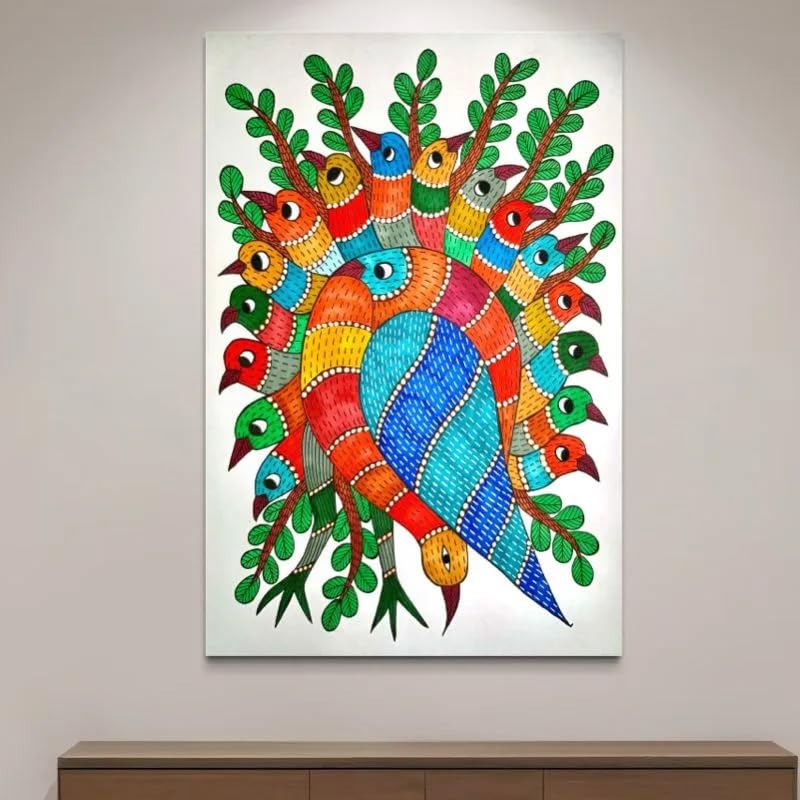
Gond painting is rooted in the cultural landscape of central India, especially Madhya Pradesh and the broader Gondwana region. Traditionally associated with Gond communities, the art reflects a close relationship with forests, animals, plants, local mythology and everyday life.
What makes Gond visually distinctive is not only the subject but the internal treatment of the subject. Animals, trees and birds may be filled with dots, dashes, lines, waves and repeated patterns. These marks create movement and texture within the larger silhouette.
Historical forms include mural-like bhittichitra traditions and geometric digna designs. Natural pigments were traditionally made from materials found in the environment, such as clay, stones, flowers and herbs.
Gond artists frequently portray deer, birds, fish, trees, tigers, mythical animals and scenes from community life. The forest is not simply a decorative backdrop. It is part of a worldview in which humans and nature are closely connected.
The contemporary Gond movement has brought this vocabulary onto paper, canvas, prints and commercial products. The Ministry of Textiles and recent Government of India cultural documentation both emphasize its patterned line-and-dot technique and its ecological storytelling.
Recommended Gond-Inspired Painting Set
Colorful Bird Tree Gond Art Inspired Pre-Drawn Canvas Set | 8 × 12 Inch Rolled Canvas | DIY Acrylic Painting Set with 12 Colors & Brush
Gond-inspired bird and tree artwork for creative home décor.
6. Odisha Pattachitra: Cloth, Temple Tradition and Mythology
Pattachitra literally refers to painting on cloth or a prepared surface. Odisha Pattachitra is strongly associated with the religious and artistic ecosystem of Puri and the Jagannath tradition, and has been practiced by the Chitrakara community.
The art has a disciplined surface preparation process. Cotton cloth is treated with materials including tamarind-seed adhesive and chalk-based coatings, creating a firm, smooth painting surface. Artists then develop the image using precise outlines, controlled colour application and intricate decorative details.
Major themes include Lord Jagannath, Krishna, Vishnu avatars, Ramayana, Mahabharata and religious narratives. Floral borders and carefully organised compositions help unify the painting.
Traditional pigments included white made from conch shell, black from soot, yellow and red mineral or earth pigments and other natural colours. Strong black outlines create the crisp silhouette associated with the art.
Pattachitra today extends beyond devotional panels into home décor, textiles, painted bottles, fashion accessories and contemporary design. Its GI registration gives formal recognition to its regional identity.
7. Kalamkari: Drawing with the Kalam on Cloth
Kalamkari is one of India’s best-known narrative textile traditions. Andhra Pradesh is home to major Kalamkari centres, especially Srikalahasti and Machilipatnam.
The name is commonly explained through the Persian-derived words associated with a qalam, or pen, and craftsmanship. In the Srikalahasti tradition, artists use a bamboo or reed pen to draw directly onto cloth and build the image through multiple stages of mordanting, dyeing and washing.
The iconography includes Ramayana, Mahabharata, Puranic stories, temple traditions, trees, flowers, creepers and mythological figures. The style can combine narrative storytelling with dense ornamental pattern.
Natural dye processes are particularly important to the traditional identity of Kalamkari. Indigo, red dye sources, pomegranate rind and other botanical materials have historically been used, with mordants helping colours bind to the cloth.
Machilipatnam Kalamkari is particularly associated with block printing, while Srikalahasti is strongly identified with hand-drawn narrative work. Both demonstrate how painting and textile craft can exist within the same heritage system.
Cheriyal painting from Telangana is a narrative scroll tradition historically used as a visual companion to storytelling. Folk performers could use the scroll to support oral narration, transforming painting into a living performance medium.
The art is famous for its red background and vibrant primary colours. Human figures are outlined strongly, with clothing, ornaments, architecture and landscapes arranged in sequential compositions.
Traditional subjects include the Ramayana, Mahabharata, local folklore, social customs, village occupations and moral narratives. Each image functions as part of a larger story rather than an isolated decorative panel.
The prepared cloth support uses materials including rice starch, tamarind-seed paste, natural pigments and adhesives. Contemporary products have adapted Cheriyal imagery into wall décor, stationery, bags, household accessories and other lifestyle objects.
The official handicrafts documentation describes Cheriyal as a narrative art form with strong continuity between painting, performance and storytelling.
9. Phad Painting: Rajasthan’s Painted Epics
Phad painting developed in Rajasthan as a long-format painted narrative tradition closely associated with folk heroes such as Pabuji and Devnarayan. Large painted cloth scrolls functioned historically as visual aids for itinerant performance and religious storytelling.
The composition is dense and episodic. Instead of a modern perspective system with one vanishing point, a Phad may place multiple characters, buildings, battles, animals and processions within the same field so that different moments of a story coexist visually.
The traditional palette includes red, yellow, green, blue and black. Artists prepare the cloth carefully, sketch compositions and apply colour in a deliberate sequence.
Alongside local legends, Phad painting has also represented religious narratives, epic episodes and historical subjects. Modern artists have adapted the once-large scroll format into framed wall art and smaller decorative pieces, but the original storytelling logic remains central to the tradition.
10. Pithora Painting: Ritual Art of Gujarat and Madhya Pradesh
Pithora painting is a ritual mural tradition associated particularly with Rathwa and related communities in Gujarat and Madhya Pradesh. Unlike artwork made primarily for commercial décor, traditional Pithora is connected with ritual, household well-being, prosperity and sacred observance.
The central imagery can include Baba Pithora and Rani Pithori, along with figures connected to the community’s sacred narratives. Horses are especially important visual elements, and the composition may also contain the sun, moon, agricultural activity, animals, gods and village scenes.
Traditional preparation involves creating a sacred wall or space before the painting. The work can involve priests, ritual specialists and artists, showing that the art is part of a broader social ceremony rather than only an isolated studio activity.
The colours can include white, red, yellow and ochre, along with brighter modern shades. Today Pithora-inspired paintings are also produced on canvas and decorative panels, but the original ritual context is essential for understanding the tradition.
Sohrai and Khovar are two related wall-painting traditions strongly associated with the Hazaribagh region of Jharkhand. They are closely connected with ceremonies, fertility, marriage, harvest and household blessings.
The paintings are remarkable because the material is often inseparable from the wall itself. Artists use layers of clay and naturally coloured earth collected from fields and forests.
In Khovar, a dark clay layer may be covered with light clay and then scratched or etched to reveal contrasting forms. Sohrai uses painted colour areas and natural motifs more broadly.
The characteristic palette includes black clay, red ochre, yellow earth and white kaolin. Animal forms, birds, branches, leaves, flowers and symbolic fertility imagery are common.
The tradition has also attracted archaeological attention because of visual similarities and geographical proximity to ancient rock-art landscapes in the region. Contemporary artists increasingly work on paper and canvas, helping the art enter galleries and urban design while retaining its earthy visual language.
12. Saura Painting: Visual Philosophy of Southern Odisha
Saura painting is associated with the Saura community of southern Odisha. It is a symbolic painting tradition rooted in ritual, nature and community memory.
Traditionally created on clay walls, Saura works can function as a form of visual communication in communities with strong oral traditions. The paintings may record beliefs, ritual events and relationships with the natural world.
One of the important themes is the sacred world surrounding Idital, along with the tree of life, sun, moon, horses, elephants, human figures and village activity.
The traditional visual field often uses white or light pigments on red or brown earthen backgrounds. Natural materials from rice, stone, flowers and leaves form part of the pigment vocabulary.
The style has now expanded into wall murals, canvas painting, stationery, pottery, wooden panels and lifestyle products. Its adaptability demonstrates how a ritual visual language can enter new formats without losing its strongest symbolic motifs.
13. Aipan Art: Ritual Geometry of Kumaon
Aipan is a traditional floor and wall painting style from the Kumaon region of Uttarakhand. It is deeply associated with ceremonies and ritual thresholds.
The classic visual combination is instantly recognisable: a geru or brick-red ground with white rice-paste designs. Artists traditionally apply the white pigment with fingers, creating lines, dots, geometric structures and ritual diagrams.
Aipan motifs include Lakshmi Yantra, Saraswati Chowki, Chamunda Hast Chowki, Nav Durga Chowki, Jyoti patterns and other occasion-specific designs. The exact motif changes according to the ceremony.
Aipan is important because its artistic meaning is tied to place. It belongs traditionally to architecture—courtyards, thresholds, walls and ritual spaces—not only to framed pictures.
Contemporary Aipan now appears on wooden chowkies, paper, trays, textiles, bookmarks, cards, wall hangings and decorative objects. The adaptation has made the style accessible to a broader audience while preserving the recognisable red-and-white visual identity.
14. Bengal Patachitra: Scrolls That Sing
Bengal Patachitra is a storytelling tradition maintained particularly by the Patuas of West Bengal. Historically, artists would paint narrative scrolls and perform accompanying songs known as Pater Gaan.
This makes Bengal Patachitra a truly interdisciplinary art form: the image, the scroll format, the song, the performer and the audience are all part of the tradition.
Subjects include Ramayana, Mahabharata, Goddess Manasa, folk legends, religious stories, village life and contemporary social issues. This ability to respond to new subjects is one reason the form remains culturally relevant.
Visual characteristics include bold outlines, bright colours, decorative borders and sequential scenes. Natural pigments historically came from plants, minerals and other local materials.
In modern practice, Patachitra may appear on paintings, textiles, bags, apparel, home décor and other products. The expansion is important because it provides new markets, but its original narrative connection to song and performance should not be forgotten.
15. Paitkar Painting: Story Scrolls of Jharkhand
Paitkar painting is a scroll painting tradition associated with Jharkhand and adjoining areas of Odisha and West Bengal. Historically, artists of the Chitrakar tradition used painted narratives together with songs to communicate myths, religious themes, moral stories and aspects of everyday life.
One of the best-known centres associated with its continuation is Amadubi in Jharkhand. Like other scroll traditions, Paitkar is strongest when understood as sequential storytelling rather than simply as a decorative image.
The traditional pigment vocabulary is especially interesting: geru red, haldi yellow, soot black, leaf green, indigo blue and lime white. Artists historically worked on materials including bark, leaves, cloth and walls.
Today the art is commonly produced on handmade paper and adapted into smaller formats such as paintings, postcards and souvenir objects. Its survival illustrates both the resilience and vulnerability of India’s narrative folk traditions.
16. Hase Chittara: Geometric Heritage of Karnataka
Hase Chittara, also called Chittara, is a folk art tradition associated with the Deevaru community of Karnataka, particularly around Sirevanthe.
The visual language is strongly geometric. Artists create motifs related to rituals, beliefs, nature and daily life using a structured arrangement of lines and forms.
Traditional painting uses locally available materials. Red, brown and yellow earth colours can create the base, while rice flour, coal, turmeric and limestone provide contrasting pigments. Paddy sticks may be used in place of conventional brushes.
The result is a highly economical but visually sophisticated graphic language. It shows how rural painting traditions can achieve complexity without requiring manufactured paints or elaborate studio equipment.
Although still tied to community heritage, Chittara has increasingly been documented and displayed in contemporary cultural contexts.
17. Mysore Ganjifa: Painted Cards as Art and Knowledge
Ganjifa began as a card-game tradition associated with Persia and entered the Indian cultural landscape during the Mughal period. In Karnataka, the Mysore court developed its own highly refined form of painted playing cards.
The Mysore tradition became more than a game. Card sets could be designed around mythology, scripture, astrology, astronomy, royal imagery and Hindu religious themes. Historical accounts connect the tradition strongly with the patronage of Maharaja Krishnaraja Wadiyar III.
The cards themselves became miniature painted surfaces. Traditional manufacture used layered materials such as cloth or paper with natural binders, followed by careful painting, detailing and finishing.
Bright colours, fine linework and occasional gold decoration give Ganjifa cards a miniature-painting character. Modern versions are often collected rather than played, and designs can be adapted into wall art, boxes, trays, bookmarks and other objects.
Ganjifa demonstrates an important point in Indian craft history: games can also serve as portable visual education, cultural memory and miniature art collections.
18. Thangka Painting: Sacred Buddhist Art of the Himalayas
Thangka painting belongs to the sacred Buddhist painting traditions of the Himalayan world and is practiced in Indian regions including Sikkim, Himachal Pradesh, Ladakh and Arunachal Pradesh.
Unlike some of the village-based folk traditions in this list, Thangka is a more formal religious and iconographic painting system. It is therefore better understood as a traditional sacred art rather than simply as folk decoration.
Artists work within strict proportional and iconographic systems. The deity’s