Unveiling the Rich Heritage of Manjusha Art from Bhagalpur
Manjusha Art, also known as Manjusha Kala or Angika folk art, is one of the most distinctive traditional art traditions associated with Bhagalpur and the Ang region of Bihar. At first glance, its bright colours, bold outlines, serpentine forms and unusual human figures may appear purely decorative. Look closer, however, and the painting becomes a visual narrative: a sequence of characters, symbols, landscapes and events connected with the enduring Bihula-Bishahari folklore.
Unlike many painting traditions that primarily present a single scene, Manjusha developed as a storytelling medium. Its ceremonial boxes, pots, scrolls, murals and later canvas paintings preserve a narrative associated with Goddess Bishahari or Mansa Devi, Bihula, Lakhindar and Chand Saudagar. The art is therefore not simply a style of painting; it is a form of visual memory through which mythology, local geography, ritual practice, community identity and artistic knowledge have been transmitted across generations.
Today, Manjusha is moving beyond its traditional ritual setting into museums, educational programmes, textiles, murals, home décor, handicrafts and contemporary design. Its recognition as a registered Geographical Indication (GI) has also strengthened its identity as a distinctive handicraft associated with Bihar.
What Is Manjusha Art?
Manjusha is a narrative folk-painting tradition primarily practised in Bhagalpur district and the wider Ang region of eastern Bihar. The name is linked to the traditional manjusha, a ceremonial box or shrine-like structure associated with Bishahari worship. Sources describe these structures as being made from materials such as bamboo, jute fibre, straw, handmade paper and related natural materials.
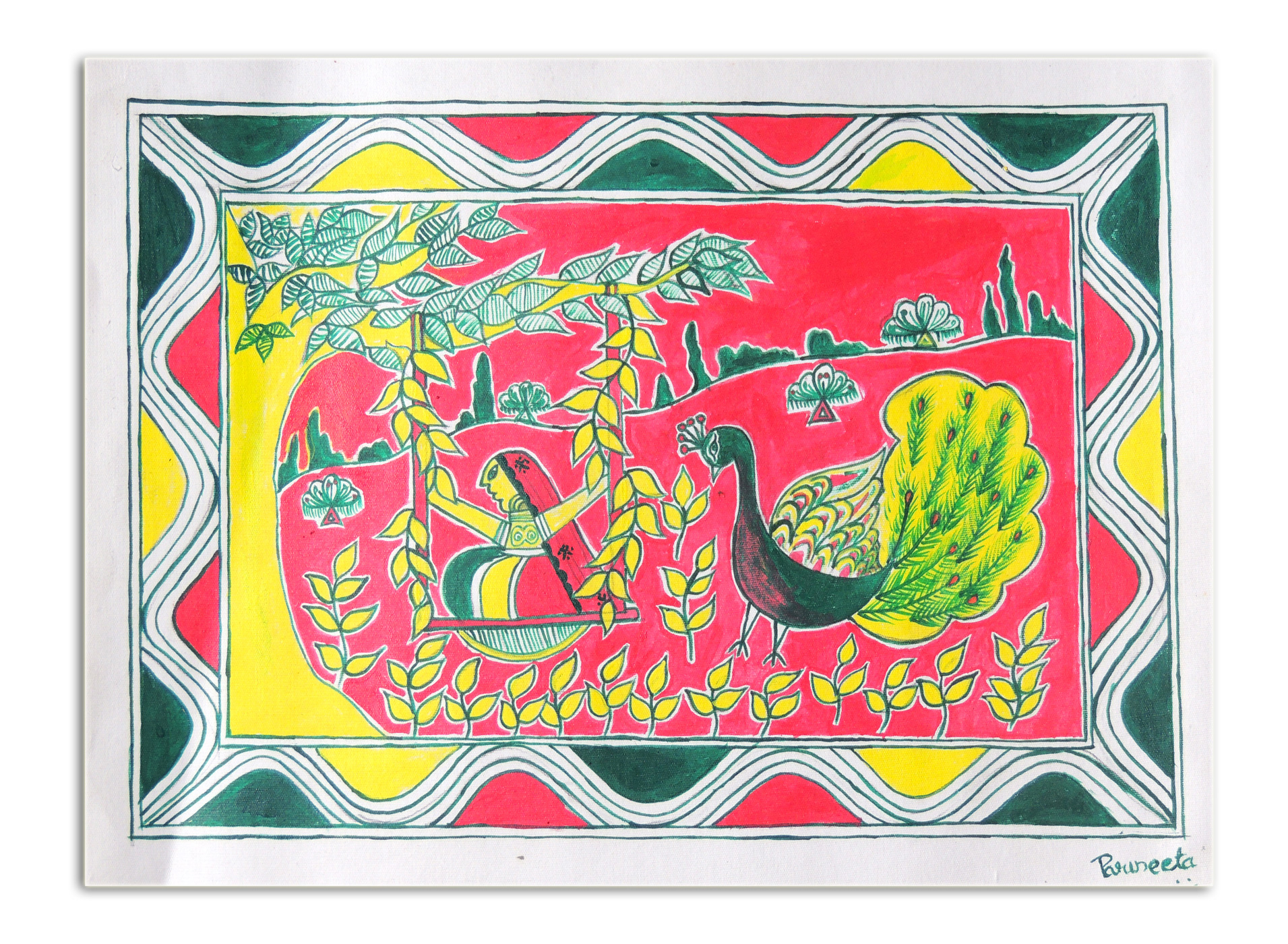
The traditional visual language is immediately recognizable. Government handicraft documentation describes a palette based on pink, green and yellow, combined with bold outlines and repetitive motifs. The style is predominantly linear, with flat areas of colour rather than realistic modelling. Human figures are often depicted in a distinctive spread-limb or “X” formation, giving the figures a symbolic rather than anatomically realistic appearance.
Manjusha is also strongly associated with sequential storytelling. Individual frames, panels or connected scenes can be read almost like chapters in a visual story. This makes Manjusha particularly important for understanding how oral folklore can become material culture.
Although Manjusha is often compared with other Indian folk-painting traditions such as Madhubani, its cultural geography and narrative foundation are different. Manjusha is rooted in the Ang region and the Bihula-Bishahari tradition, while Madhubani painting is associated with the Mithila region and contains a much broader range of religious, social and mythological subjects.
Origins and Evolution of Manjusha Art
From Anga Pradesh to Present-Day Bhagalpur
The historical identity of Manjusha is inseparable from the ancient cultural landscape of Anga Pradesh, the historic region of which Bhagalpur is an important modern centre. Scholarly and heritage sources commonly associate the development of Manjusha with traditions that were established in the region by the early medieval period, often citing the seventh century CE.
At the same time, it is important to distinguish between documented historical evidence and traditional interpretations. Some Manjusha practitioners and heritage researchers have proposed much earlier connections, including parallels between serpent imagery found in archaeological material around Bhagalpur and motifs found in Manjusha. Such claims are culturally interesting but should be regarded as interpretive rather than as conclusively established dating.
What can be stated with greater confidence is that the visual tradition became deeply embedded in the religious and social life of the Ang region through the Bishahari Puja and the Bihula-Bishahari folklore.
The Traditional Craft Communities
Historical accounts describe a traditional division of artistic labour involving communities such as the Kumbhakar and Malakar. Kumbhakar artisans were associated with making ritual vessels and structures, while Malakar artists played an important role in making and painting ceremonial manjushas as well as related paintings.
This community-based production system demonstrates an important feature of Indian folk art: the “artist” was not always an isolated painter. Rather, the object could emerge from a chain of specialized skills involving material preparation, construction, painting, ritual use and community participation.
The Bihula-Bishahari Story as the Foundation
The central narrative of Manjusha is the Bihula-Bishahari or Bihula-Vishahari folklore. In its best-known form, the story centres on Bihula, whose husband Lakhindar dies from snakebite. Bihula refuses to accept the finality of death and undertakes a difficult journey seeking divine intervention and the restoration of her husband’s life.
The story connects human devotion with the powers of the serpent goddess Bishahari or Mansa Devi. It also introduces Chand Saudagar, the family conflict surrounding divine worship, and a sequence of supernatural events through which the heroine’s determination becomes the driving force of the narrative.
For Manjusha artists, the story provides more than subject matter. It supplies a complete symbolic vocabulary: snakes, boats, flowers, rivers, divine figures, the kalash, celestial forms and specific objects held by the Bishahari sisters all help communicate the narrative.
W.G. Archer and the 20th-Century Rediscovery
Manjusha remained strongly connected with local ritual practice for generations. During the early twentieth century, however, the tradition attracted wider attention. Heritage accounts discuss the work of British civil servant W. G. Archer and his wife, who documented regional folk paintings during the colonial period. Manjusha paintings were collected and studied, and examples were transferred from traditional ritual objects to canvas for exhibition.
This period brought a degree of external recognition, but it did not guarantee long-term survival. After independence, the decline of traditional patronage and changing social practices contributed to a reduction in the number of practitioners.
Revival Efforts from the 1980s
By the 1980s, Manjusha was regarded as being at serious risk of disappearing. According to Sahapedia’s documentation, the Bihar government’s Department of Information and Public Relations launched an awareness and revival initiative during 1984–85. Government personnel worked with surviving practitioners and used visual presentations in villages to explain the cultural importance of the art.
Later initiatives involving artists, development organizations, exhibitions, training programmes and institutions such as NABARD helped connect Manjusha with livelihood opportunities. This marked an important transition: preservation was no longer limited to keeping an old painting style alive; it increasingly involved making the craft economically and socially sustainable.
The Bihula-Bishahari Narrative: A Story Painted in Sequence
The heart of Manjusha Art is storytelling. To understand the symbols, it is useful to understand the narrative structure behind them.
The Birth of the Five Bishaharis
One important episode in the folklore tells of Lord Shiva bathing at Sonada, where five strands of his hair fell into the water and became five lotuses. The flowers eventually revealed their true forms as five sisters associated with Bishahari worship.
The sisters are identified in Manjusha traditions as Jaya Bishahari, Dhotila Bhavani, Padmavathi, Mynah Bishahari and Maya Bishahari or Manasa Bishahari. They become connected with Shiva and with the power to neutralize snake poison.
The story helps explain why serpents, flowers, water, divine figures and the five sisters occur so prominently in Manjusha imagery.
Bihula’s Journey
The best-known part of the story follows Bihula after the death of Lakhindar. She undertakes a journey with his body in the hope of reaching the divine realm and obtaining his restoration to life.
Her journey across the river and through different encounters is particularly suited to the sequential structure of Manjusha. A series of visual panels can show movement from one episode to another, allowing a viewer to follow the narrative without relying entirely on written text.
The Bihar Museum describes this story as a journey from the darkness of death toward the light of life and connects the narrative with themes such as devotion, resilience, sorrow, hope and women’s agency.
This is one reason why Manjusha should be understood as both religious art and cultural storytelling. The story is sacred, but it is also deeply human: it addresses loyalty, courage, social dignity, family conflict, suffering and the desire to overcome death.
The Significance of Symbols in Manjusha Art
Every major visual component of traditional Manjusha can carry meaning. Rather than filling the picture surface simply for decoration, artists work within a symbolic vocabulary related to the folklore and ritual tradition.
Symbol or Motif
Meaning and Narrative Association
Snake / Serpent
Central to Bishahari worship and the Bihula-Bishahari story; associated with both danger and divine protective power.
Five Bishaharis
Represent the five serpent-associated sisters who form an important part of the mythology.
Champa Flower
A recurring floral motif associated with the natural and symbolic world of the story.
Lotus
Connected with the story of the five sisters emerging from lotus forms.
Kalash
A sacred vessel; in the Bishahari tradition, the amrit kalash is associated with healing and restoration.
Sun
Used as a distinguishing emblem of Dhotila Bishahari and contributes to the symbolic celestial vocabulary.
Mynah Bird
Identifies Mynah Bishahari in traditional representations.
Bel Leaf
Associated with Shiva; the bel motif is frequently used within Manjusha borders.
Leheriya / Waves
Represents water and Bihula’s river journey.
Sarp Ladi
A repeated snake form used prominently in ornamental borders.
Boat
Represents Bihula’s journey and the movement through the riverine landscape.
Fish and Aquatic Forms
Reflect the river and natural environment of the Ang region.
Tree and Floral Motifs
Connect the story with the local environment and wider natural world.
The Five Bishaharis and Their Identifying Attributes
One of the most sophisticated features of Manjusha symbolism is that the five Bishaharis can be differentiated by the objects they hold. Heritage documentation identifies the traditional associations as follows:
Jaya Bishahari: bow, arrow, amrit kalash and snake.
Dhotila Bishahari: rising sun and snake.
Padmavathi Bishahari: lotus and snake.
Mynah Bishahari: mynah bird and snake.
Maya/Manasa Bishahari: snakes held in both hands.
This makes Manjusha particularly useful as a system of visual identification. A knowledgeable viewer can identify a character not merely from facial appearance but from the symbolic object accompanying the figure.
Why Are the Figures Drawn in an “X” Shape?
The distinctive human figures of Manjusha are usually stylized rather than anatomically realistic. Their extended limbs form a recognizable X-like posture. This visual language gives the characters a strong graphic presence and keeps the storytelling emphasis on their role and symbolic identity rather than naturalistic portraiture.
The simplified figures also demonstrate an important characteristic of folk art: visual conventions are often deliberately repeated so that viewers can recognize characters and actions immediately.
The Importance of Borders
In Manjusha, the border is not a secondary decorative frame. It is an integral part of the composition. Traditional border motifs include:
Leheriya: wave-like forms associated with the river and journey.
Sarp Ladi: repeated serpent forms.
Tribhuja: triangular geometric patterns.
Mokha: a traditional repeated decorative motif.
Belpatra: leaf-inspired forms associated with Shiva.
The border creates visual rhythm and encloses the narrative. In traditional Manjusha aesthetics, it helps complete the artwork rather than merely surrounding it.
The Three-Colour Language of Manjusha Art
One of the strongest characteristics of traditional Manjusha is its disciplined colour palette. Government handicraft documentation and recent government cultural communication describe the principal traditional colours as pink, green and yellow.
Historically, artists worked with naturally derived colour sources. Green is particularly important in the drawing and outlining system documented by several heritage sources, although black outlines are also used by contemporary artists.
The limited palette produces a striking visual effect. Instead of relying on many shades, the artist obtains variety through line, repetition, pattern, spacing and the relationship between the three primary colours.
This restricted palette should be understood as an important part of the identity of traditional Manjusha. At the same time, contemporary artists have experimented with additional shades and materials to make the art suitable for modern interiors, textiles and commercial products.
This balance between tradition and innovation remains one of the central questions in the preservation of Manjusha Art: how far can an art form evolve without losing the visual grammar that makes it recognizably Manjusha?
Manjusha Art, Bhagalpur and Local Culture
Manjusha is inseparable from the cultural history of Bhagalpur. The region’s identity as part of historic Anga, its riverine geography and the continuing memory of the Bihula-Bishahari tradition all contribute to the character of the art.
The relationship between landscape and storytelling is particularly strong. Rivers are not simply backgrounds in the paintings; they form part of Bihula’s journey. Flora and fauna become visual participants in the narrative. The art therefore creates a connection between mythology and the physical environment of eastern Bihar.
The tradition also demonstrates how folk art can preserve local knowledge. When a painted panel shows a river, boat, flower, serpent, sacred pot or deity, it may simultaneously communicate mythology, ritual meaning and local artistic convention.
The Role of Manjusha Art in Bishahari Puja and Festivals
Bishahari Puja is one of the most important cultural contexts for understanding Manjusha. The festival is associated with the worship of Bishahari or Mansa Devi and is observed in eastern Bihar and, in related forms, in parts of Assam and West Bengal.
Traditional Manjushas were made as ceremonial objects associated with the worship. Paintings on these structures transformed the ritual object into a storytelling surface.
Manjusha painting was also traditionally associated with Kalratri, described in heritage documentation as the first night after a wedding. Murals and narrative imagery linked with Bihula were used in domestic contexts and were believed to bring auspiciousness and good fortune to newly married couples.
The annual Bihula tradition remains particularly significant in Champanagar, an area associated in local history and folklore with the Bihula narrative. The continuing relationship between place, festival and story demonstrates how Manjusha is rooted not merely in an artistic style, but in a living regional cultural landscape.
Manjusha Art as Women’s Storytelling and Cultural Memory
The Bihula story places a woman’s determination at the centre of the narrative. Bihula is not portrayed simply as a passive figure waiting for divine mercy. She undertakes a dangerous journey, negotiates with supernatural powers and fights to restore her husband’s life.
The Bihar Museum specifically interprets the story as containing themes of women’s empowerment and social dignity. This gives Manjusha a contemporary relevance beyond its ritual function. A traditional painting can therefore be viewed simultaneously as folklore, devotional art and a story of courage and agency.
The preservation of Manjusha is consequently also the preservation of a regional narrative in which female resilience occupies a central position.
From Ritual Objects to Canvas: The Evolution of Manjusha
Originally linked strongly with ceremonial structures and ritual painting, Manjusha has gradually expanded into multiple media.
Today, artists create Manjusha on:
Handmade paper and traditional paper surfaces
Canvas and framed paintings
Cloth and textiles
Silk and regional handloom fabrics
Wooden and decorative objects
Murals and interior surfaces
Home décor and craft products
Educational and cultural display materials
The Bihar Museum notes that the art has moved beyond traditional manjushas and pots into canvas, paper and fabric. Contemporary heritage documentation also records the application of Manjusha motifs to commercial products and public cultural projects.
This expansion is important for survival because an art form that exists only within a narrow ritual economy can become vulnerable when the original social practices decline. New applications create new audiences and new income opportunities for artisans.
Contemporary Applications of Manjusha Art
Textiles and Fashion
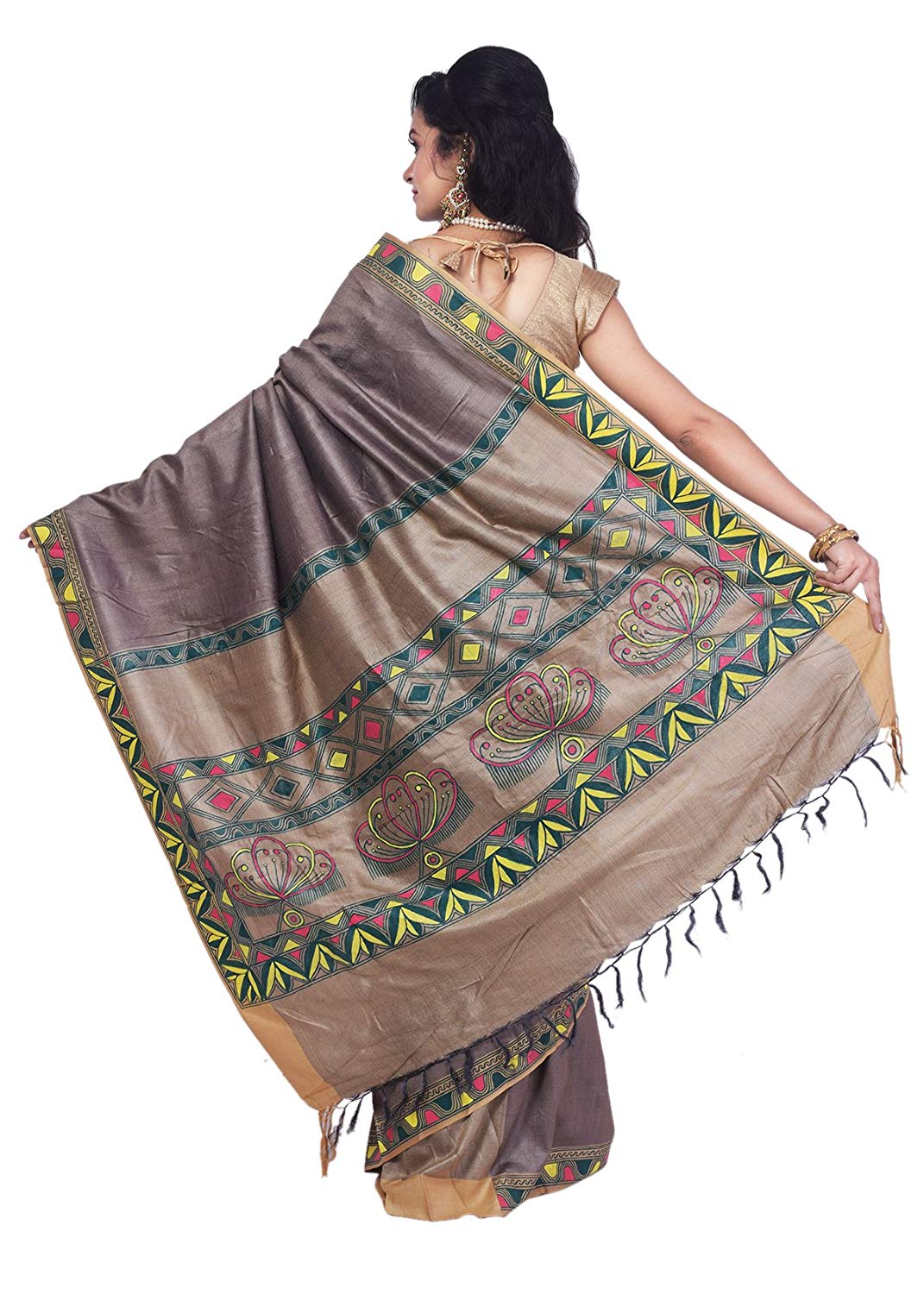
Bhagalpur is internationally associated with silk and handloom traditions, making textiles a natural contemporary medium for Manjusha. Artists have experimented with applying Manjusha imagery to silk and other fabrics, connecting two major elements of the region’s cultural identity.
Manjusha-inspired motifs can now appear on sarees, dupattas, stoles, shawls, fabric panels, furnishings and other textile products. Such applications can introduce the art to audiences who may never encounter a traditional ceremonial box.
Home Décor
Canvas panels, wall art, trays, boxes, planters, wooden articles and decorative objects offer Manjusha artists another route into the modern market. The bold linear style works particularly well for contemporary interior spaces because the motifs remain visually strong even when adapted to different sizes and surfaces.
Murals and Public Art
Large-scale murals can turn Manjusha into a form of public storytelling. Instead of being displayed in a private household, the narrative becomes visible to students, visitors and the wider community.
A notable recent example was reported by the Press Information Bureau in August 2026. The Indian Council for Cultural Relations, working with the Bhagalpur district administration, conducted a Manjusha workshop in Bhagalpur for students of Kilkari Bihar Bal Bhawan and women inmates of Shaheed Jubba Sahni Central Jail. Following the workshop, participants created a permanent Manjusha mural inside the jail premises, inaugurated on 19 August 2026 to commemorate the Bihula Festival.
Education and Cultural Workshops
Workshops are especially valuable because Manjusha is an intangible heritage as much as a visual style. A printed reproduction can preserve an image, but practical training can preserve technique, symbolism, sequence, colour knowledge and artistic vocabulary.
Schools, museums, universities, cultural organizations and community groups can therefore play an important role by treating Manjusha as a subject for practical learning rather than merely an object for display.
GI Recognition and Why It Matters
Manjusha Art is a registered Geographical Indication of Bihar. According to the official Intellectual Property India GI Registry, the application was filed by the Upendra Maharathi Shilp Anushandhan Sansthan under Application No. 656. The registration certificate was issued on 14 September 2021, for handicrafts in Bihar.
GI recognition does not by itself guarantee the survival of a craft, but it provides an important legal and cultural framework for identifying the geographical and traditional identity associated with the product.
For Manjusha, this is especially meaningful because the art’s identity is deeply connected with Bhagalpur, the Ang region, the Bihula-Bishahari story and traditional community knowledge.
Consumers can contribute to preservation by looking beyond decorative similarity and learning about the provenance of the artwork, the artist and the cultural tradition behind the motifs.
Preservation Challenges Facing Manjusha Art
Despite its revival, Manjusha still faces challenges common to many regional folk traditions.
Declining Traditional Knowledge
When an art form is traditionally maintained by a small number of families or communities, knowledge can disappear rapidly when younger generations move toward other occupations.
Commercial Adaptation Versus Authenticity
Modern products can increase demand, but excessive adaptation may weaken the visual language that makes Manjusha distinctive. Traditional colours, borders, character conventions and narrative symbolism can easily be replaced by generic “folk-art” decoration.
Limited Public Awareness
Manjusha remains less internationally familiar than some Indian folk-art traditions. Greater visibility through museums, educational institutions, exhibitions, cultural tourism and responsible publishing can help address this gap.
Need for Sustainable Artisan Livelihoods
Preservation becomes much stronger when artists can earn a fair income from their skills. Training, design development, market access, exhibitions, digital platforms and institutional support can help make the tradition economically sustainable.
How Manjusha Art Can Be Preserved for Future Generations
A successful preservation strategy should protect both the physical artwork and the knowledge system behind it.
Document traditional motifs: Record the names, forms and meanings of traditional symbols and borders.
Document the Bihula-Bishahari narrative: Preserve local versions of the story, songs, rituals and oral histories.
Teach young artists: Introduce Manjusha workshops in schools, colleges and cultural institutions.
Support artisan livelihoods: Connect artists with ethical markets, exhibitions, design development and direct-to-consumer platforms.
Preserve traditional visual language: Contemporary experimentation should retain recognizable Manjusha characteristics where the artwork is presented as traditional Manjusha.
Strengthen museum collections: Museums can preserve historic examples and document the work of contemporary artists.
Promote responsible cultural tourism: Bhagalpur’s festivals, museums, craft demonstrations and artisan communities can become part of heritage tourism without reducing the tradition to a mere souvenir.
Use digital archives: High-quality photography, oral-history recordings, artist interviews and educational resources can make the tradition accessible to future generations.
The recent 2026 ICCR workshop in Bhagalpur demonstrates one promising direction: combining artistic education, community participation, cultural awareness and permanent public artworks.
Manjusha Art in Museums and Heritage Institutions
Museums play a crucial role because they can connect a living craft with historical documentation. The Bihar Museum has a Manjusha collection object depicting the Bihula-Vishahari folklore. Its documentation identifies scenes including Shiva bathing in Sonadah, Chand Saudagar, the kalash, snakes, Bihula, Vishahari, Lakhindar, Netula Dhobi, the Ganges and celestial realms.
The museum’s example also illustrates the sequential structure of Manjusha: several episodes of the narrative appear across connected visual sections within a single composition.
Such museum collections demonstrate that Manjusha is not merely a decorative craft. It is a historical source for understanding the folklore, ritual imagination and cultural geography of eastern Bihar.
Manjusha Art and the Future of Indian Folk Art
The future of Manjusha may lie in a balanced approach to preservation. Complete isolation from contemporary markets can make the tradition economically fragile, while unlimited commercial modification can weaken its identity.
A more sustainable model combines heritage accuracy with creative innovation. Traditional motifs can remain intact while artists explore new surfaces, scales, products and visual narratives. Contemporary Manjusha can therefore speak to new audiences while remaining connected to its Bhagalpur roots.
Digital publishing, online exhibitions, social media storytelling, museum education, craft workshops and collaborations with textile and design industries can all contribute to this process.
Most importantly, the story should remain at the heart of the art. When a snake, boat, lotus, kalash or wave appears in Manjusha, it should not become merely an attractive pattern. It should continue to carry the memory of Bihula, Bishahari, Lakhindar, Chand Saudagar and the cultural world of Anga.
Explore Manjusha Art and Related Books
For readers interested in exploring Manjusha artwork and its cultural traditions, the following products can serve as decorative, educational or collectible resources.
1. Anukirti Manjusha Art Canvas Jhanp & Vishahri Painting – 5″ x 7″
About: A small-format Manjusha-inspired artwork featuring Jhanp and Vishahri imagery, suitable for readers and collectors interested in traditional Indian folk-art décor.
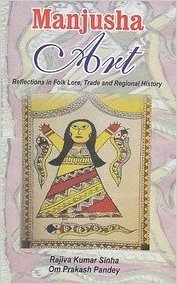
2. Manjusha Art: Reflections in Folk Lore Trade and Regional History
About: A useful resource for readers who want to explore Manjusha through folklore, regional history, cultural traditions and the historical context of the Ang region.
3. Paper Mansa Devi Painting – Manjusha Art Products Frame Canvas
About: A framed Manjusha-style depiction of Mansa Devi, offering a decorative way to bring the visual language of Bihar’s traditional folk art into a contemporary setting.
Affiliate Disclosure: Some links in this section may be affiliate links. If you purchase through an affiliate link, the website may receive a small commission at no additional cost to you. Product availability, pricing and specifications may change on Amazon.
Why Manjusha Art Deserves Greater Recognition
Manjusha is more than a colourful painting tradition from Bhagalpur. It is a bridge between folklore, ritual, geography, memory and visual storytelling. Its serpents recall the mythology of Bishahari. Its waves evoke Bihula’s journey. Its lotus recalls the five sisters. Its kalash represents sacred power and healing. Its borders create continuity, while its sequential panels turn painting into narrative.
The art also tells another story: the story of survival. Once threatened by declining patronage and a shrinking artisan base, Manjusha has been revived through government initiatives, artist-led programmes, development organizations, museum collections, workshops and contemporary applications.
Its registration as a GI and its continued presence in cultural programmes demonstrate that Manjusha is not a relic of the past. It remains a living tradition, capable of evolving while retaining its connection to the cultural memory of Bhagalpur and Anga.
Preserving Manjusha, therefore, means preserving not only paintings but also the stories, symbols, festivals, skills and communities that give those paintings meaning.
Frequently Asked Questions About Manjusha Art
Where did Manjusha Art originate?
Manjusha Art is primarily associated with Bhagalpur and the historic Ang region of eastern Bihar. It developed in close association with the Bihula-Bishahari folklore and Bishahari worship.
What is the main story depicted in Manjusha paintings?
The central narrative is the Bihula-Bishahari story, including Bihula’s journey to seek restoration of her husband Lakhindar after his death from snakebite and the mythology of Bishahari or Mansa Devi.
Why is Manjusha called a narrative or scroll painting?
Because the story can be represented through a sequence of connected scenes or panels. The viewer follows the narrative visually from one episode to another.
Which colours are traditionally used in Manjusha Art?
The traditional palette is strongly associated with pink, green and yellow, supported by bold outlines and linear drawing.
What are the most important Manjusha motifs?
Important motifs include snakes, lotus, champa, bel leaf, kalash, sun, moon, fish, birds, boats, trees and distinctive decorative borders such as leheriya and sarp ladi.
When did Manjusha receive a GI registration?
Manjusha Art was registered as a Geographical Indication in 2021. The official GI Registry records the certificate date as 14 September 2021.
Is Manjusha Art still practised today?
Yes. Contemporary artists continue to produce Manjusha paintings on canvas, paper, cloth, textiles, murals and decorative objects, while workshops and institutional programmes are introducing the tradition to new generations.
Research Sources and Further Reading
This article has been prepared using a combination of government, museum, heritage and academic-oriented sources for historical and cultural cross-checking.