Ang Pradesh: History, Culture and Traditional Art of Ancient Bihar
Ask people about the ancient history of Bihar, and names like Magadha, Pataliputra and Nalanda usually come first. Ang Pradesh rarely receives the same attention. Yet this historic region of eastern Bihar was home to an important ancient kingdom, a renowned Buddhist university, remarkable metal craftsmanship and a distinctive folk painting tradition that has survived against the odds.
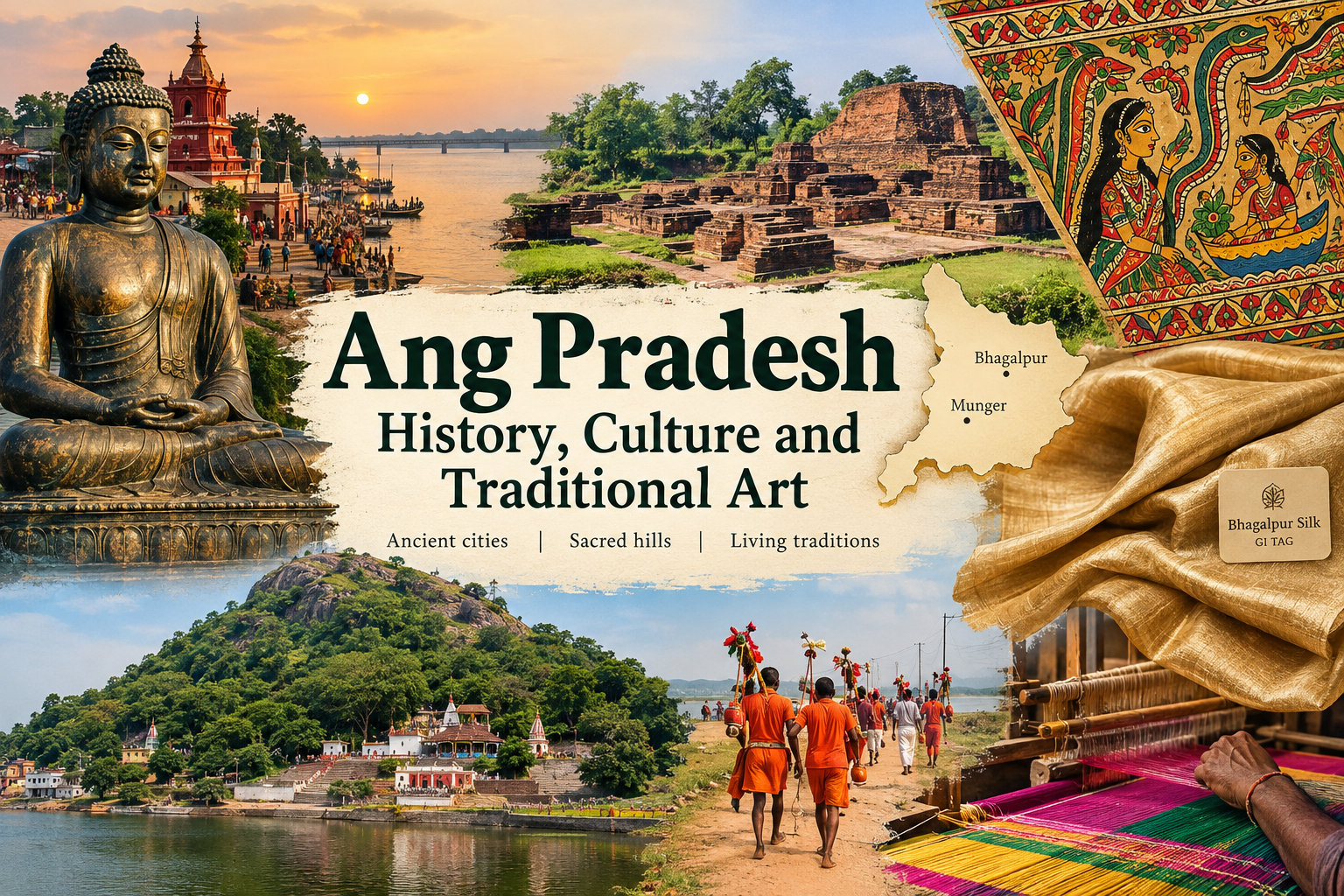
Centred around present-day Bhagalpur and Munger, the cultural landscape of Ang Pradesh connects ancient history with living traditions. Its heritage can be seen in the archaeological remains of Vikramshila, the sacred sites of Mandar Hill, the weaving communities of Bhagalpur, the Angika language and the storytelling tradition of Manjusha Art.
Some parts of this history are supported by archaeological evidence and historical texts, while others survive through religious traditions and local legends. Together, they reveal a fascinating story of a region whose contribution to Indian culture deserves greater recognition.
The Land and the Name of Ang Pradesh
Ang Pradesh, also known as the ancient region of Anga, occupied an important position in eastern India. Its historical heartland is associated with present-day Bhagalpur and Munger in Bihar. The wider cultural region also connects with areas such as Banka, Jamui, Khagaria and neighbouring parts of Jharkhand.
The precise boundaries of ancient Anga changed over time and cannot be mapped directly onto modern districts. However, the Ganga River and its surrounding plains played a central role in the region’s development. Fertile agricultural land, river-based transport and commercial connections helped settlements grow into important centres of trade and political activity.
The name Anga also appears in religious and literary traditions. According to a popular interpretation found in the Ramayana tradition, the region received its name from the Sanskrit word anga, meaning a limb, through a story involving Shiva and Kamadeva. This is a traditional explanation rather than an established historical account.
What is clear is that Anga was recognised as a significant region of ancient India. Its identity developed through political kingdoms, religious movements, trade networks and the cultural traditions of its people.
Champa: The Ancient Capital of Anga
Champa was the capital of the ancient Anga kingdom and an important city in early Indian history. It is traditionally associated with the area around present-day Champanagar and Champapur in Bhagalpur.
Ancient Buddhist texts mention Champa among the important cities of northern India. Its location near the Ganga and the Champa River supported commercial activity and connections with other settlements. Merchants, travellers and religious communities helped make the city part of a wider network of cultural and economic exchange.
Anga is mentioned in early Indian literature, including the Atharvaveda. By the time of the Buddha and Mahavira, it was counted among the sixteen Mahajanapadas described in Buddhist tradition.
According to historical and religious accounts, the Magadha ruler Bimbisara conquered Anga, bringing the kingdom under Magadhan influence. Its political independence declined, but the region continued to retain a distinctive cultural identity.
Champa is also important in Jain tradition. Champapuri is revered as a sacred place associated with Vasupujya, the twelfth Jain Tirthankara. The religious associations of the area continue to attract pilgrims and connect its ancient past with living spiritual traditions.
Karna and the Legends of Anga
Anga occupies a memorable place in the Mahabharata through the story of Karna, one of the epic’s most complex and admired characters.
According to the Mahabharata, Duryodhana made Karna the king of Anga. The gesture gave Karna royal status at a time when questions about his birth and social position prevented him from receiving the recognition he believed he deserved. Karna became known as Angaraja and remains widely remembered for his generosity, loyalty and tragic fate.
In Bhagalpur, Karnagarh near Nathnagar is associated in local tradition with Karna. Such connections form an important part of regional folklore and historical memory. However, a definitive archaeological identification of the site as Karna’s fort has not been established.
Stories like these show how the cultural landscape of Ang Pradesh combines historical places with the enduring power of epic narratives. They also remind visitors to distinguish between archaeological evidence and traditions that have been passed down through generations.
Vikramshila: A Great Centre of Buddhist Learning
One of the most significant historical landmarks of the Ang region is Vikramshila Mahavihara, located at Antichak near Kahalgaon in present-day Bhagalpur district.
Vikramshila was established during the Pala period, traditionally attributed to the reign of King Dharmapala in the late eighth or early ninth century. It became one of the major Buddhist centres of learning in eastern India, alongside institutions such as Nalanda and Odantapuri.
The institution was particularly associated with advanced Buddhist philosophy and Vajrayana traditions. Scholars and monks studied, taught and exchanged ideas within a network that extended beyond the Indian subcontinent.
Its most famous scholar was Atisha Dipankara Shrijnana. After serving at Vikramshila, Atisha travelled to Tibet in the eleventh century, where his teachings contributed significantly to the revival and development of Tibetan Buddhism.
This connection gives Vikramshila an importance that reaches far beyond Bihar. A centre of learning in the Bhagalpur region helped shape religious and intellectual traditions across the Himalayas.
What the Archaeological Remains Reveal
Archaeological excavations at Vikramshila have revealed the scale and organisation of this ancient institution. Excavations by Patna University during the 1960s and subsequent work by the Archaeological Survey of India uncovered the remains of a large, roughly square monastery, with monastic cells arranged around a central courtyard.
The complex includes a central cruciform stupa, structural remains of monastic buildings, votive stupas and terracotta plaques. The decorative material depicts religious figures, animals and other scenes, offering clues about the artistic and cultural environment of the period.
Vikramshila is generally believed to have been destroyed during the military campaigns that disrupted Buddhist institutions in eastern India around the end of the twelfth century. The precise circumstances of its decline remain a subject of historical discussion.
In February 2024, reports announced that the Archaeological Survey of India had resumed excavation work at Antichak after a gap of several decades. Continued archaeological research may reveal more about the institution and its place in India’s educational history.
The Sultanganj Buddha: A Masterpiece of Ancient Metalwork
Sultanganj, a town in Bhagalpur district beside the Ganga, is associated with one of the most remarkable surviving metal sculptures from ancient India: the Sultanganj Buddha.
The large copper-alloy statue was discovered in 1861–62 during railway construction work supervised by British engineer E. B. Harris. The sculpture is approximately 2.3 metres tall and weighs around 500 kilograms. It is widely recognised for its scale, craftsmanship and the technical skill required to cast such a substantial metal figure.
The statue is generally dated to around the fifth to seventh centuries CE. It was transported to England and entered the collection of the Birmingham Museum and Art Gallery, where it remains an important example of early Indian Buddhist art.
Its journey also raises questions about the movement of India’s cultural heritage during the colonial period. For the people of Bihar, the sculpture represents both the artistic achievements of the region and the importance of documenting and preserving local history.
Sultanganj and the Kanwar Yatra
Sultanganj is not only associated with ancient sculpture but also with an important living religious tradition. The Ajgaivinath Shiva temple stands beside the Ganga and becomes a major destination during the Hindu month of Sawan.
During the Kanwar Yatra, devotees collect sacred Ganga water and carry it to Shiva temples, including Baba Baidyanath Dham in Deoghar, Jharkhand. The pilgrimage route connects communities across Bihar and Jharkhand and brings together devotion, physical endurance, folk traditions and local commerce.
The annual journey illustrates how rivers and sacred landscapes continue to shape the religious life of the Ang region.
Mandar Hill: Where Hindu and Jain Traditions Meet
Located in Banka district, approximately 45 kilometres south of Bhagalpur, Mandar Hill is among the region’s most recognisable sacred landscapes.
In Hindu mythology, the hill is identified with Mount Mandarachal, the mountain used as a churning rod during the Samudra Manthan, the legendary churning of the ocean. Temples and sacred sites around the hill reflect this association.
The Papharni pond lies at the foot of the hill, while temples and religious structures around the area attract visitors throughout the year. Mandar Hill is also significant to Jain tradition because of its association with Vasupujya.
The Bounsi Mela, traditionally held around Makar Sankranti in January, is one of the best-known fairs in the region. It brings together religious observances, local markets, crafts and community celebrations.
Mandar Hill is a powerful example of how different religious traditions share the same landscape, adding depth to the cultural identity of Ang Pradesh.
Angika: The Language and Voice of Ang Pradesh
Angika is a major marker of regional identity in the Bhagalpur and Munger areas and neighbouring parts of Jharkhand. It belongs to the Indo-Aryan language family and carries a rich tradition of folk songs, oral narratives, sayings and everyday expressions.
For generations, Angika has helped people share family histories, celebrate festivals and communicate local knowledge. Its spoken forms preserve expressions of regional life that are not always represented in formal written histories.
The language’s classification has been debated. It has often been treated as a variety of Maithili or grouped within broader linguistic categories, while many speakers emphasise its distinct identity and seek greater official recognition.
Angika has historically been associated with writing systems such as Anga Lipi and Kaithi, while Devanagari is widely used today. Its preservation depends on education, publishing, cultural documentation and opportunities for younger speakers to read and write in their language.
For Ang Pradesh, protecting Angika is not simply a linguistic issue. It is also a way of safeguarding local literature, folk traditions and the cultural memory of the region.
Manjusha Art: The Traditional Storytelling Art of Ang Pradesh
If one traditional art form captures the storytelling spirit of Ang Pradesh, it is Manjusha Art, closely associated with Bhagalpur and the folklore of Bihula and Bishahari.
Manjusha is more than a decorative painting style. It is a narrative folk art in which characters, symbols and scenes help communicate a story. Its visual tradition connects religious belief, oral storytelling, community rituals and the artistic skills of local families.
The Legend of Bihula and Bishahari
The central story revolves around Bihula, her husband Bala, the merchant Chand Sadagar and the serpent goddess Manasa, known locally as Bishahari.
According to the folk narrative, Chand Sadagar refuses to worship Manasa. As a consequence of the conflict, Bala is bitten by a snake on his wedding night. Bihula refuses to accept his death and undertakes a difficult journey with his body, seeking divine intervention to restore his life.
Her determination, devotion and courage form the emotional heart of the story. The narrative explores faith, suffering, perseverance and the relationship between human beings and divine forces.
The legend remains closely connected with Bishahari Puja, celebrated in the region around the traditional festival period associated with Nag Panchami. The Bishahari temple at Champanagar is among the places linked with this cultural tradition.
Local accounts also refer to a manuscript containing the Bihula-Bishahari story in Kaithi script at Ishakchak in Bhagalpur. Such manuscripts and oral versions are valuable reminders of how regional storytelling traditions have been preserved.
How to Recognise Traditional Manjusha Art
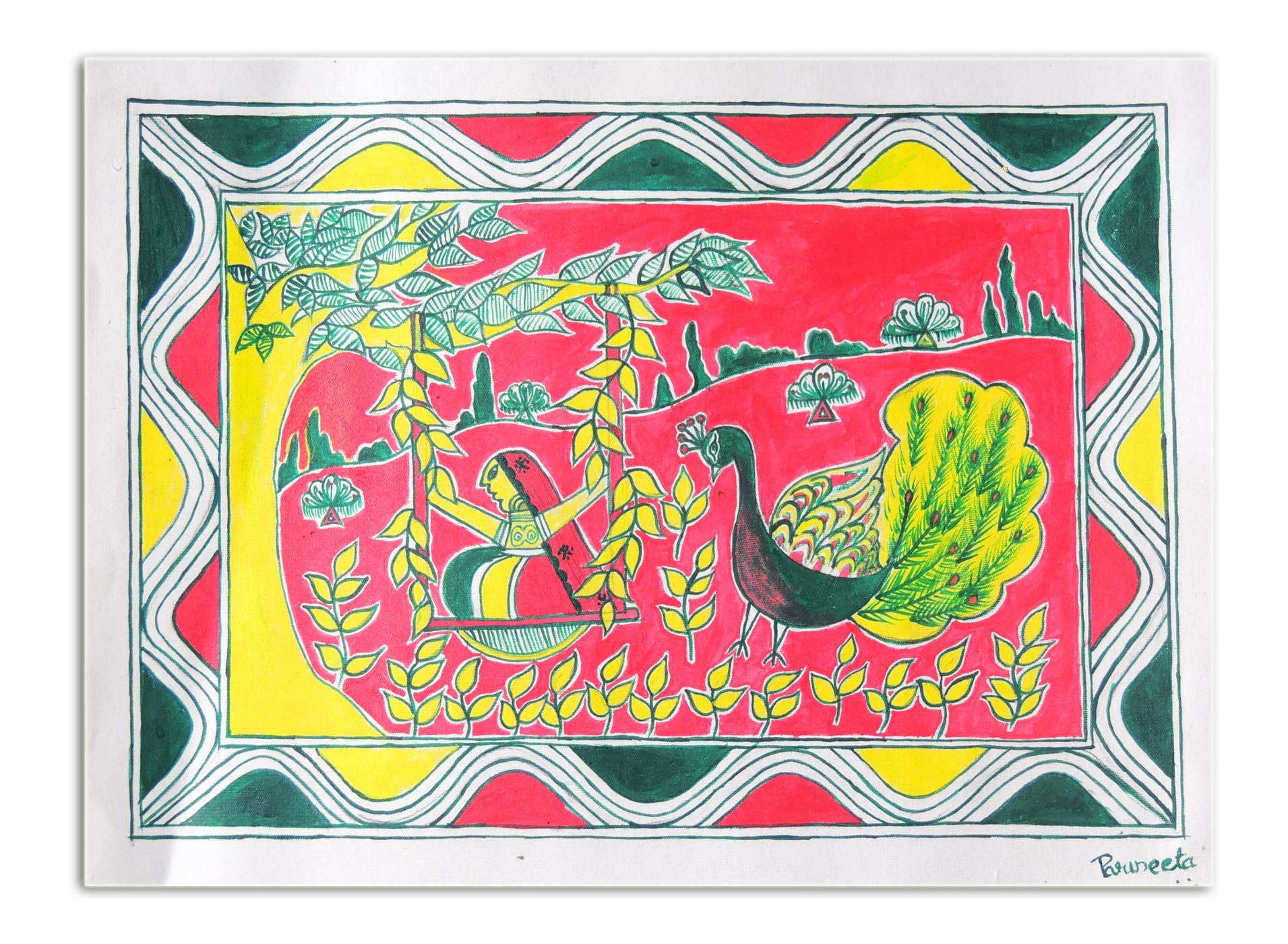
Distinctive colours: Traditional Manjusha painting is recognised by its characteristic use of pink or red, green and yellow, supported by strong black outlines and a light background.
Decorative borders: Borders are essential to many traditional compositions. Common patterns include wavy lines, triangles, leaf-inspired forms and serpent motifs.
Storytelling figures: Bihula, Bala, Bishahari, Chand Sadagar and other figures from the folklore appear alongside symbolic animals, flowers and religious imagery.
Nature-inspired motifs: Snakes, fish, birds, lotuses, the sun and the moon help create a visual language connected with local beliefs and the natural world.
Traditional structures: The art has been associated with ritual objects and structures made from materials such as bamboo, paper and other locally available resources for festival use.
Sequential narration: Scenes and motifs can work together to communicate episodes of a larger story rather than functioning only as independent decorative images.
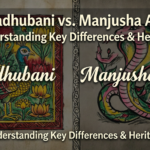
These features give Manjusha Art a distinctive identity among Bihar’s folk painting traditions. Its emphasis on narrative, characteristic borders and a limited palette helps distinguish it from other regional art forms, including Madhubani painting.
From a Community Tradition to a Wider Audience
Traditional Manjusha Art has been associated particularly with Mali and Kumbhakar artisan communities. Local accounts connect the Mali tradition with Lahsan Mali, who is said to have decorated Bihula’s raft in the folklore.
During the twentieth century, the art faced a serious risk of decline as traditional practices lost visibility and fewer practitioners continued the work. Chakravarti Devi of Champanagar is frequently remembered for her role in preserving the painting tradition. Artists such as Jyotish Chand Sharma and Nirmala Devi also contributed to revival efforts, including initiatives associated with the Bihar government’s information department during the 1980s.
Later artists and cultural advocates helped introduce Manjusha Art to exhibitions, workshops and new audiences. Contemporary practitioners have also adapted its motifs for textiles, wall hangings, painted boxes, stationery, home décor and other creative products.
A major milestone came when Manjusha Art received a Geographical Indication (GI) registration in September 2021. The registration recognises its regional association and distinctive identity. The GI record identifies the application under certificate number 386.
Today, Manjusha Art offers a meaningful way to connect traditional storytelling with contemporary design. However, its long-term survival depends on preserving its traditional visual language, acknowledging artists and ensuring that artisans benefit from the growing interest in regional crafts.
Bhagalpur is widely known as the Silk City of India because of its long-standing association with silk weaving. Bhagalpuri silk, particularly Tussar silk, is admired for its distinctive texture, natural appearance and understated sheen.
The weaving tradition supports a network of artisans, weavers, dyers, traders and other workers whose skills have been passed down through generations. Bhagalpuri textiles are used to make sarees, dupattas, stoles, dress materials, shawls and other products for everyday wear and special occasions.
Tussar silk is especially valued for its characteristic texture and naturally rich appearance. Depending on the yarn, weave and finishing, the fabric can range from simple, understated textiles to elegant garments with decorative patterns.
Bhagalpur’s weaving heritage is an important part of the region’s living economy. Nathnagar and other local weaving areas are associated with textile production, while the wider industry connects traditional craftsmanship with markets across India.
Bhagalpur Silk received Geographical Indication registration in 2013, strengthening recognition of its regional identity. The registration is an important part of the broader effort to distinguish traditional products and protect their reputation.
EthnicAlive Bhagalpuri Silk Store on Amazon
Challenges Facing the Silk Industry
Despite its reputation, the traditional weaving industry faces challenges, including rising production costs, changing market conditions, competition from imitation products and difficulties in securing fair prices for handloom work.
When machine-made products are marketed in ways that confuse buyers about their origin or production method, genuine artisans can struggle to compete. The survival of the industry therefore depends partly on informed consumers who value craftsmanship and ask questions about the fabric they purchase.
Buyers can support the region’s heritage by seeking transparent information about the material, weaving technique, producer and origin of a textile. Purchasing directly from reputable artisan groups or established handloom sellers can also help strengthen connections between craftspeople and customers.
Preserving Bhagalpuri silk is about more than protecting a famous fabric. It is about sustaining livelihoods, maintaining traditional knowledge and keeping an important part of Ang Pradesh’s identity alive.
Folk Culture, Festivals and Religious Traditions
The cultural life of Ang Pradesh is shaped by festivals, seasonal rituals, local deities, family customs and community gatherings. These traditions connect the region’s historical identity with everyday life.
Chhath Puja
Chhath Puja is one of Bihar’s most important festivals. Devotees worship the setting and rising Sun, often gathering beside rivers, ponds and other water bodies. The observance is associated with gratitude, discipline, family well-being and respect for nature.
In Ang Pradesh, as in other parts of Bihar, Chhath also brings people together through folk songs, traditional offerings and family gatherings. For many families living away from home, the festival carries strong memories of their native villages and communities.
Bishahari Puja
Bishahari Puja is closely connected with the worship of the serpent goddess and the legend of Bihula. Its rituals and artistic traditions have helped preserve the stories that inspire Manjusha paintings.
Shiva Worship and Sawan
Shiva worship is another important part of regional religious life. During Sawan, devotees travel to sacred places such as Ajgaivinath in Sultanganj, while the Kanwar Yatra connects the Ganga with pilgrimage destinations in Jharkhand.
Durga Puja, Kali Puja, Diwali, Holi and other festivals are also celebrated across the region, each reflecting the customs and community traditions of local people.
Traditional Crafts and Contemporary Creativity
Ang Pradesh’s creative heritage extends beyond paintings and textiles. Local craft traditions and contemporary artisan enterprises use regional motifs to create objects that connect traditional design with modern life.
Manjusha-inspired designs can be seen on wall hangings, wooden and paper boxes, trays, notebooks, fabric accessories, greeting cards and decorative products. Motifs such as snakes, lotuses, birds, fish and geometric borders provide a recognisable visual identity.
When these designs are adapted for new products, it is important to understand their cultural origins. Respectful adaptation, accurate storytelling and proper recognition of artists help prevent traditional art from becoming disconnected from the communities that developed it.
Craft exhibitions, artisan workshops, educational programmes and online marketplaces can introduce these products to wider audiences. They can also create new income opportunities, particularly for younger artisans interested in combining inherited skills with contemporary design.
Food, Everyday Life and the Angika Identity
The heritage of Ang Pradesh is also reflected in its food, speech and everyday customs. Agriculture, seasonal produce and family traditions have shaped the region’s food culture over generations.
Rice, pulses, vegetables and regional sweets form part of local food practices, while festival meals bring families and communities together. Recipes and cooking methods often vary between households and localities, reflecting the diversity of the wider region.
Angika adds another important layer to this identity. Through songs, stories, proverbs and everyday conversation, the language carries expressions of local humour, affection, history and community life.
These ordinary cultural practices deserve attention alongside monuments and famous art forms. They are an essential part of what makes Ang Pradesh a living cultural region rather than simply a historical name.
Places to Explore in Ang Pradesh
Visitors interested in the history, religion and traditional arts of the region can explore several important places in and around Bhagalpur.
Vikramshila Archaeological Site, Antichak: Explore the remains of the historic Buddhist Mahavihara and learn about its contribution to education and Buddhist philosophy.
Champanagar and Champapur: Discover the area’s association with ancient Champa, Jain traditions and the folklore connected with Bishahari.
Sultanganj: Visit the riverside setting of Ajgaivinath Shiva temple and explore the area’s religious importance. The famous Sultanganj Buddha is now housed in Birmingham, England.
Mandar Hill, Banka: Experience a sacred landscape associated with Hindu and Jain traditions, with temples, the Papharni pond and the annual Bounsi Mela.
Nathnagar and Bhagalpur’s silk markets: Learn about Bhagalpuri silk and, where possible, meet weavers or purchase textiles from reputable local producers.
Bhagalpur Museum: Explore regional historical and cultural collections, subject to current opening arrangements and available exhibitions.
Visitors should check opening hours, access conditions and local transport options before travelling. Attending a craft exhibition or meeting a traditional artisan can make a visit more meaningful by connecting historical sites with the people who continue to preserve the region’s heritage.
Preserving the Heritage of Ang Pradesh
Ang Pradesh has a rich cultural legacy, but many aspects of its history and traditional arts remain less visible in mainstream discussions of Indian heritage.
Archaeological research can improve understanding of ancient settlements and educational institutions. At the same time, language documentation, folk-art education, museum exhibitions and support for traditional artisans can help protect the region’s living culture.
Digital platforms also offer new opportunities. Websites, online galleries, educational videos and social media can introduce Angika literature, Manjusha paintings and Bhagalpuri textiles to people who may never have visited eastern Bihar.
Preservation, however, should go beyond promotion. Historical claims need to be supported by reliable evidence, local legends should be presented as legends, and artists and weavers should receive proper recognition for their knowledge and work.
Supporting genuine craft production, encouraging young people to learn traditional skills and making regional history accessible to students are practical ways to help this heritage thrive.
Why Ang Pradesh Still Matters
Ang Pradesh offers a different way of understanding India’s past. Its story includes the ancient trading city of Champa, the Buddhist scholars of Vikramshila, the remarkable metal craftsmanship represented by the Sultanganj Buddha and the sacred landscape of Mandar Hill.
Its cultural identity also survives in Angika speech, the stories of Bihula and Bishahari, the distinctive borders of Manjusha Art and the skilled hands of Bhagalpur’s silk weavers.
These traditions show that history is not confined to monuments or the names of ancient kings. It also lives in songs, rituals, paintings, fabrics and the knowledge passed from one generation to the next.
Discovering Ang Pradesh means recognising an important chapter of Bihar’s history and a living culture that continues to evolve. By documenting its stories, respecting its traditions and supporting its artisans, we can help ensure that this remarkable heritage receives the attention it deserves.
Sources and Further Reading
Archaeological Survey of India: information and excavation records relating to Vikramshila at Antichak.
Historical and archaeological publications on the Pala period and Vikramshila Mahavihara.
Birmingham Museums Trust: collection information about the Sultanganj Buddha.
Geographical Indications Registry, Government of India: records for Manjusha Art and Bhagalpur Silk.
Early Buddhist and Jain literature relating to Champa and ancient Anga.
Government and academic publications on the history, languages and cultural heritage of Bihar.
Research and documentation relating to Manjusha Art, Bihula-Bishahari folklore and Bhagalpuri handloom traditions.