Traditional Indian Wedding Clothing by Region: A Complete Guide to India’s Bridal and Groom Attire
India is a country where a wedding is much more than a ceremony. It is a celebration of family, heritage, traditions, craftsmanship and cultural identity. From the colourful wedding celebrations of Rajasthan to the elegant silk sarees of South India, every region has its own way of dressing a bride and groom for one of life’s most memorable occasions.
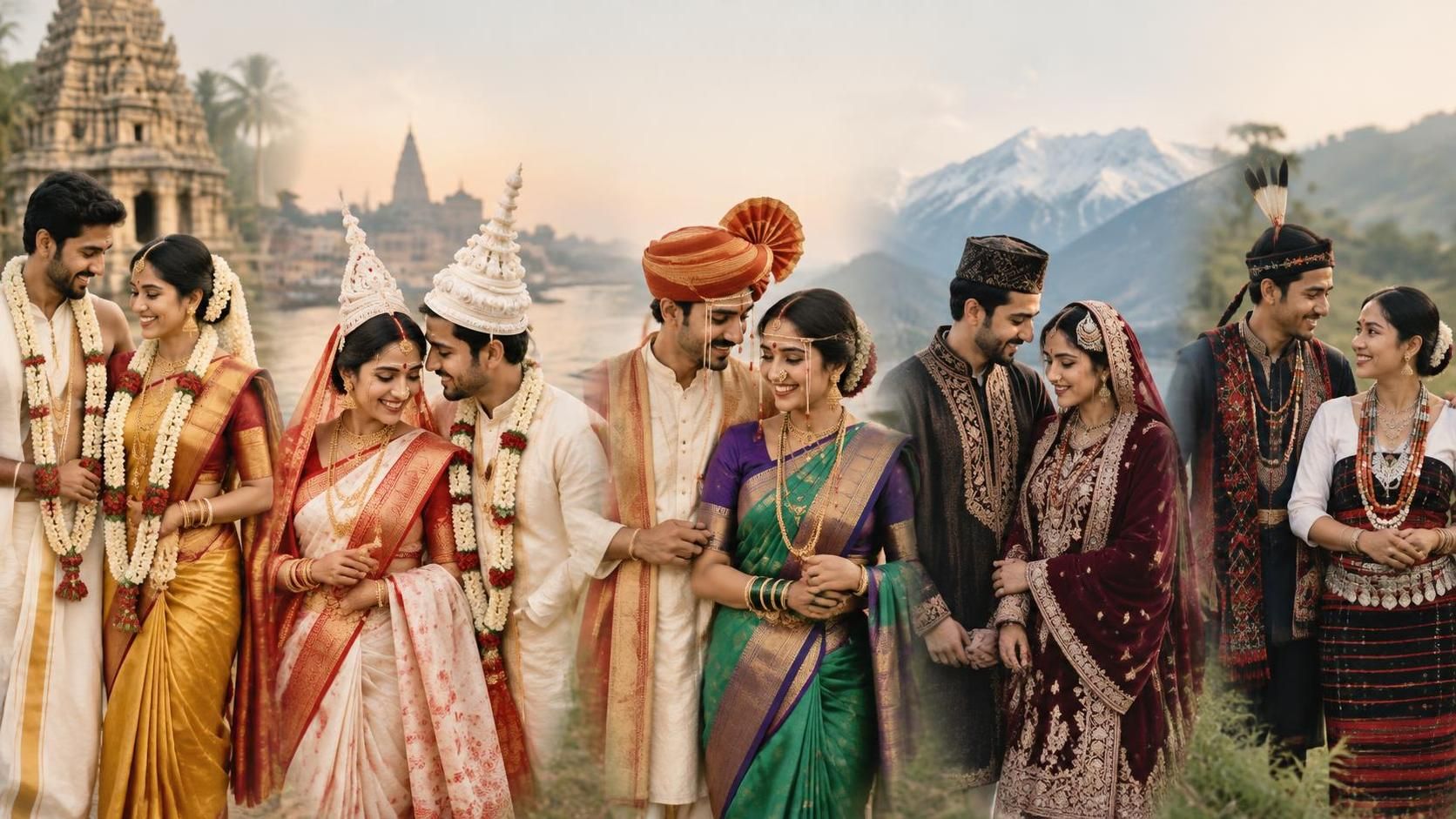
Traditional Indian wedding clothing reflects the history, geography, beliefs and artistic skills of the communities that wear it. A bride in Punjab may choose an elaborate red lehenga with a Phulkari dupatta, while a Bengali bride is traditionally recognised by her red-and-white saree and distinctive Shola crown. In Kerala, the understated beauty of an ivory Kasavu saree tells a different story, while an Assamese bride may wear a beautifully woven Mekhela Chador made from traditional silk.
The same diversity can be seen in men’s wedding attire. Turbans, embroidered sherwanis, traditional dhotis, veshtis, angavastrams and regional jackets all have their own cultural significance.
Although contemporary Indian weddings increasingly incorporate modern fashion, traditional clothing continues to hold an important place in wedding rituals.
Let’s explore the traditional wedding clothing of India, region by region, and discover the fabrics, garments and craftsmanship that make each tradition special.
1. North India: Royal Elegance and Colourful Wedding Traditions
North Indian wedding fashion is known for its rich embroidery, flowing garments, elaborate jewellery and vibrant colours. Red, maroon, pink and gold are popular bridal choices, although contemporary brides also experiment with pastels and other shades.
Punjab – Lehenga, Phulkari and the Traditional Punjabi Look
Punjabi weddings are famous for their energy, music and colourful celebrations. Traditional Punjabi brides commonly wear red, maroon or pink lehengas, salwar suits or richly embroidered bridal outfits.
A Phulkari dupatta is one of the most recognisable elements of Punjabi textile heritage. Its colourful floral embroidery gives traditional wedding clothing a distinctive regional identity.
The bridal look is often completed with a chooda (traditional bridal bangles), kalire, jewellery and a dupatta draped over the head during important ceremonies.
Punjabi grooms traditionally wear a sherwani or kurta-pajama with a turban, known as a pagri or dastaar. A decorated sehra may also be worn during the wedding procession.
Haryana – Ghagra, Daaman and Traditional Bridal Clothing
Traditional Haryanvi clothing has a strong connection with rural culture and community identity.
Women have traditionally worn garments such as the daaman (a flared skirt), kurti and chunder (a long veil or head covering). For weddings, these outfits may be made more elaborate with embroidery, decorative borders and traditional jewellery.
Men traditionally wear dhoti-kurta, kurta-pajama or other regional festive garments, sometimes accompanied by a pagri.
The clothing reflects a simple yet colourful cultural heritage, although contemporary Haryanvi weddings also feature lehengas, sarees and designer sherwanis.
Signature elements: Daaman, kurti, chunder, traditional jewellery and pagri.
Himachal Pradesh – Pattu, Woollen Shawls and Mountain Wedding Traditions
Himachal Pradesh has a distinctive clothing heritage shaped by its mountainous landscape and climate.
Traditional women’s clothing includes regional dresses, ghagra and pattu, a woollen wrap or shawl. A traditional Himachali cap and beautifully woven shawls are also important elements of festive clothing.
For weddings, regional variations can be seen across Kullu, Kinnaur, Chamba and other areas. Brides may wear traditional garments with elaborate jewellery and distinctive head coverings.
Men traditionally wear regional woollen garments, kurta-chola styles, trousers or dhoti-based outfits, accompanied by a Himachali cap.
The Kullu shawl, known for its colourful geometric patterns, is an important example of the state’s weaving heritage.
Uttarakhand – Rangwali Pichora and Kumaoni Wedding Attire
Uttarakhand’s wedding traditions are especially interesting because Kumaoni and Garhwali communities have their own clothing customs.
One of the most recognisable garments is the Rangwali Pichora, a traditional yellow or saffron-coloured ceremonial veil decorated with red motifs. It is particularly associated with Kumaoni weddings and religious occasions.
Kumaoni brides may wear a saree or traditional outfit with the Pichora draped over their head and shoulders.
Garhwali wedding clothing also features traditional sarees, ghagra-based garments, jewellery and regional head coverings.
Men traditionally wear dhoti-kurta or other regional festive clothing, sometimes complemented by a traditional cap.
Signature elements: Rangwali Pichora, traditional sarees, regional jewellery and ceremonial head coverings.
Uttar Pradesh has one of India’s most celebrated textile traditions, particularly the Banarasi silk saree.
Banarasi sarees are known for their intricate brocade patterns, zari work and luxurious silk fabric. They are especially popular for weddings and important family celebrations.
Brides may wear red, maroon or other richly coloured Banarasi sarees, lehengas or traditional bridal ensembles. The wedding fashion of Lucknow also reflects the beauty of Chikankari embroidery.
Men traditionally wear sherwanis, achkans, kurta-pajamas or dhoti-based outfits depending on their family and community traditions.
Signature elements: Banarasi silk, gold and silver zari, Lucknow Chikankari, lehenga and sherwani.
Jammu and Kashmir – Pheran, Traditional Embroidery and Pashmina
Kashmir has a distinctive clothing heritage influenced by its cold climate, traditional crafts and cultural history.
The Pheran, a long and loose traditional garment, is an important part of Kashmiri clothing for both men and women.
For weddings, Kashmiri brides may wear richly embroidered pherans or traditional bridal ensembles, often featuring intricate Tilla embroidery, jewellery and distinctive head coverings.
Kashmiri wedding clothing also reflects the influence of Pashmina shawls and fine textile craftsmanship.
Men may wear traditional pherans, embroidered garments and formal outfits suited to the wedding ceremony.
Signature elements: Pheran, Tilla embroidery, Pashmina shawls and traditional Kashmiri jewellery.
2. West India: Vibrant Colours, Embroidery and Royal Heritage
Western India is home to some of the country’s most recognisable wedding garments and textile crafts. Bandhani, Patola, mirror work, Paithani silk and traditional turbans are important parts of the region’s cultural identity.
Rajasthan – Rajputi Poshak, Ghagra Choli and Royal Wedding Fashion
Rajasthan is perhaps one of the most visually distinctive regions when it comes to traditional Indian wedding clothing.
Rajasthani brides traditionally wear a Rajputi Poshak or a richly decorated ghagra-choli with an odhni. These outfits often feature gota-patti work, zari, embroidery and colourful patterns.
The bridal odhni is especially important and is traditionally draped over the head and shoulders.
Bandhani and Leheriya textiles are also popular in Rajasthan, adding beautiful patterns and vibrant colours to wedding clothing.
Rajasthani grooms traditionally wear an angrakha, achkan or sherwani with a dhoti or churidar. A colourful safa or pagri, sometimes decorated with a kalgi, completes the royal appearance.
Signature elements: Rajputi Poshak, ghagra-choli, Bandhani, Leheriya, Gota Patti and traditional safa.
Gujarat – Panetar, Gharchola and Chaniya Choli
Gujarati wedding clothing is famous for its colourful textiles and meaningful family traditions.
The Panetar saree, traditionally associated with Gujarati bridal customs, often features a white or ivory base with red and gold details. It is commonly gifted to the bride by her maternal family.
Another important garment is the Gharchola, a traditional saree recognised for its distinctive checked pattern and decorative zari work.
Gujarati brides may also wear a chaniya choli, particularly for pre-wedding celebrations such as Garba and other festive occasions.
Men traditionally wear a kediyu and chorno or formal kurta-pajama, sometimes accompanied by a colourful turban.
The region’s Patola and Bandhani textiles are also closely associated with its rich textile heritage.
Signature elements: Panetar, Gharchola, Chaniya Choli, Patola, Bandhani and Kediyu.
Maharashtra – Nauvari Saree and Paithani Silk
Maharashtrian wedding clothing has a distinctive identity, particularly because of the traditional Nauvari saree.
The Nauvari is a nine-yard saree draped in a style that allows greater freedom of movement. It is often worn with traditional jewellery, a nath (nose ring), green glass bangles and other ceremonial accessories.
Paithani silk sarees are another celebrated part of Maharashtrian textile heritage. They are known for their elaborate pallus, zari work and peacock or lotus-inspired motifs.
Brides may wear Paithani or other silk sarees depending on their family traditions and wedding rituals.
Maharashtrian grooms traditionally wear a dhoti, kurta or traditional outfit with a pheta, the distinctive regional turban.
Signature elements: Nauvari saree, Paithani silk, pheta, nath and green bangles.
Goa – Kunbi Saree and Konkani Wedding Traditions
Goa’s traditional clothing reflects a combination of Konkani heritage, regional customs and historical influences.
The Kunbi saree is an important part of Goa’s indigenous textile identity. It is traditionally associated with the Kunbi community and is recognised for its distinctive checked patterns.
Wedding attire varies across Goan communities. Traditional sarees, Pano Bhaju and other regional garments may be worn according to family and religious customs.
Men’s clothing also varies, with traditional dhoti-based garments and contemporary formal wedding outfits both being common.
Signature elements: Kunbi saree, Pano Bhaju, traditional jewellery and Konkani ceremonial clothing.
3. Central India: Handloom Beauty and Tribal Textile Heritage
Central India has a rich textile culture influenced by indigenous communities, traditional weaving and regional craftsmanship.
Madhya Pradesh – Chanderi, Maheshwari and Traditional Sarees
Madhya Pradesh is known for two celebrated textile traditions: Chanderi and Maheshwari.
Chanderi sarees are admired for their lightweight texture, delicate appearance and fine zari borders. Maheshwari sarees are recognised for their distinctive borders and elegant combination of cotton and silk.
For weddings, brides may choose traditional silk sarees, Banarasi sarees, lehengas or other festive garments. Chanderi and Maheshwari fabrics are also popular for pre-wedding functions and family celebrations.
Men may wear sherwanis, kurta-pajamas or dhoti-based traditional clothing.
Signature elements: Chanderi silk-cotton, Maheshwari sarees, zari borders and traditional handloom fabrics.
Chhattisgarh – Kosa Silk and Traditional Community Attire
Chhattisgarh has a strong connection with Kosa silk, a variety of Indian Tussar silk appreciated for its natural texture and rich appearance.
Kosa silk sarees are an attractive choice for traditional occasions and weddings. Their understated elegance makes them suitable for both brides and other family members.
Different communities across Chhattisgarh also maintain their own traditional clothing customs. Tribal wedding attire may include distinctive drapes, woven textiles, jewellery and decorative accessories.
Men traditionally wear dhoti-based garments, shirts, jackets or other regional clothing depending on the community.
Signature elements: Kosa silk, Tussar textiles, traditional sarees and indigenous ornaments.
4. East India: Silk Sarees, Traditional Drapes and Cultural Symbolism
Eastern India is known for its beautiful sarees, intricate weaving techniques and wedding traditions that often attach special significance to colours, jewellery and ceremonial clothing.
Bihar has a rich textile heritage, and its wedding clothing reflects the traditions of different communities across the state.
Traditional Bihari brides may wear sarees, silk garments or lehengas, depending on family customs and regional preferences.
A particularly interesting tradition in many Maithil and other Bihari Hindu wedding families is the use of the yellow Piyari, a ceremonial garment associated with wedding rituals.
Bhagalpur, widely known as the Silk City of India, is famous for Bhagalpuri silk and Tussar silk. These fabrics are valued for their texture, natural appearance and craftsmanship.
Bhagalpuri silk sarees and other silk garments are beautiful choices for wedding functions and traditional celebrations.
Men traditionally wear dhoti-kurta, kurta-pajama or sherwani depending on the ceremony and community.
Signature elements: Piyari, Bhagalpuri silk, Tussar silk, traditional sarees and dhoti-kurta.
Jharkhand – Tussar Silk and Indigenous Wedding Traditions
Jharkhand has a strong tradition of indigenous textiles and community-specific wedding clothing.
Tussar silk is one of the region’s important textile products. Its natural golden appearance and textured surface make it suitable for traditional sarees and festive garments.
Wedding attire varies considerably among Santhal, Munda, Oraon, Ho and other communities.
Women may wear traditional sarees with distinctive draping styles, woven borders and regional jewellery. Men often wear dhoti-based clothing, shirts, traditional wraps or community-specific garments.
Many indigenous wedding celebrations place particular importance on traditional ornaments, natural materials and locally woven fabrics.
Signature elements: Tussar silk, indigenous woven textiles, traditional sarees and community jewellery.
West Bengal – Laal Paar Saree, Banarasi Silk and Shola Mukut
Bengali bridal fashion is among the most recognisable wedding traditions in India.
The traditional Bengali bride often wears a red Banarasi silk saree or another richly decorated red bridal saree. The characteristic white-and-red combination is especially significant in Bengali wedding culture.
A traditional Bengali bridal look may include a Shola Mukut, a decorative white headpiece made from shola pith, along with the traditional mukut and elaborate jewellery.
Other important elements include shakha and pola bangles, alta on the feet and the distinctive way the saree is draped.
Bengali grooms traditionally wear a white or cream dhoti and panjabi (kurta). A topor, another traditional headpiece made from shola pith, is worn during important wedding rituals.
Signature elements: Red Banarasi saree, laal-paar saree, Shola Mukut, Topor, shakha-pola and dhoti-panjabi.
Odisha – Sambalpuri, Bomkai and Traditional Odia Bridal Sarees
Odisha has a remarkable handloom tradition, particularly its Sambalpuri and Bomkai sarees.
Sambalpuri sarees are known for their Bandha ikat weaving technique, in which yarns are tied and dyed before weaving to create intricate patterns.
Bomkai sarees are appreciated for their distinctive borders, traditional motifs and decorative weaving.
Odia brides traditionally wear silk or other regional sarees, often in red, maroon or other auspicious colours. The exact bridal outfit varies across communities and family traditions.
Men traditionally wear dhoti and kurta or other ceremonial garments.
Signature elements: Sambalpuri ikat, Bomkai saree, traditional silk, woven motifs and regional jewellery.
5. South India: Silk Sarees, Gold Jewellery and Timeless Elegance
South Indian wedding clothing is particularly famous for its luxurious silk sarees, traditional draping styles, gold jewellery and ceremonial garments worn by grooms.
Tamil Nadu – Kanchipuram Silk and Traditional Veshti
Tamil Nadu has one of India’s most celebrated bridal textile traditions: the Kanchipuram silk saree.
Also known as Kanjivaram silk, these sarees are recognised for their rich silk fabric, contrasting borders, intricate zari work and traditional motifs.
Tamil brides commonly wear richly coloured Kanchipuram sarees, often in red, maroon, green or other vibrant shades. Temple jewellery, gold ornaments and traditional hair decorations complete the bridal look.
Men traditionally wear a veshti with a shirt or angavastram. During important wedding rituals, the traditional white veshti with a gold border is especially popular.
Kerala’s traditional wedding clothing is admired for its elegance and simplicity.
The Kasavu saree, also called Kerala saree or Settu Mundu in different contexts, is recognised by its off-white or cream fabric and distinctive gold border.
Many Kerala Hindu brides wear the traditional Kasavu saree or a richly decorated silk saree during wedding ceremonies. The outfit is complemented by traditional gold jewellery and jasmine flowers.
Men traditionally wear the mundu, often paired with a shirt or an angavastram.
Kerala’s wedding clothing traditions also vary across Hindu, Muslim and Christian communities, each having its own ceremonial styles and preferences.
Signature elements: Kasavu, Settu Mundu, gold borders, mundu, jasmine flowers and traditional gold jewellery.
Karnataka – Mysore Silk, Ilkal Saree and Traditional Panche
Karnataka has several important textile traditions, including Mysore silk and Ilkal sarees.
Mysore silk is known for its smooth texture, elegant appearance and zari borders. Ilkal sarees are recognised for their distinctive pallu and traditional weaving techniques.
Brides may wear Mysore silk, Ilkal or other regional silk sarees depending on their community and wedding customs.
Men traditionally wear the panche (dhoti), paired with a shirt or angavastram.
Wedding attire varies across Karnataka, including distinct customs among Kannada, Kodava, Tulu and other communities.
Signature elements: Mysore silk, Ilkal saree, traditional panche, angavastram and regional jewellery.
Andhra Pradesh – Traditional Pattu Sarees and Madhuparkam
Andhra Pradesh is known for its beautiful silk sarees, including Dharmavaram and Uppada varieties.
Traditional Telugu wedding clothing often includes a richly decorated pattu saree for the bride. Red, yellow, green and gold are popular colours, although preferences vary between families.
One distinctive wedding custom is Madhuparkam, which is associated with the traditional white or off-white clothing used during important wedding rituals. Brides and grooms may wear these garments according to their family’s customs.
The groom traditionally wears a pancha or dhoti with an upper garment or angavastram.
Signature elements: Pattu sarees, Dharmavaram silk, Uppada silk, Madhuparkam, pancha and traditional gold jewellery.
Telangana – Pochampally Ikat and Gadwal Sarees
Telangana has a distinctive handloom heritage, especially its Pochampally Ikat and Gadwal sarees.
Pochampally Ikat is famous for its geometric patterns created through the traditional tie-and-dye technique applied to yarns before weaving.
Gadwal sarees are known for their contrasting borders and distinctive combination of silk and cotton.
Brides may wear Pochampally, Gadwal or other traditional silk sarees depending on regional and family customs.
Men traditionally wear pancha and kurta or other formal traditional garments.
6. Northeast India: Unique Weaves and Community-Specific Wedding Attire
Northeast India deserves special attention because its wedding clothing traditions are exceptionally diverse.
The region is home to numerous communities, each with its own textiles, weaving techniques, ceremonial garments and distinctive patterns.
Assam – Mekhela Chador and Muga Silk
Assamese wedding attire is especially admired for its beautiful silk garments.
The Mekhela Chador is a traditional two-piece garment worn by Assamese women. It consists of a lower garment called the Mekhela and an upper draped piece called the Chador.
Assamese brides may wear a traditional Mekhela Chador made from Muga silk, Pat silk or Eri silk.
Muga silk is particularly special because of its natural golden appearance and strong connection with Assam’s textile heritage.
The traditional Assamese groom may wear a dhoti and kurta, accompanied by a Gamosa or other ceremonial garments.
Signature elements: Mekhela Chador, Muga silk, Pat silk, Eri silk and Gamosa.
Arunachal Pradesh is home to many indigenous communities, including the Apatani, Adi, Nyishi, Monpa and Mishmi.
As a result, there is no single traditional wedding outfit for the entire state.
Women’s clothing may include handwoven skirts, wraps, jackets and distinctive textile accessories. Men’s ceremonial attire also varies among communities and may include traditional coats, wraps, shawls and headgear.
Traditional weaving often features geometric patterns and colours associated with community identity.
Signature elements: Indigenous handwoven textiles, traditional wraps, community patterns and ceremonial accessories.
Manipur – Potloi and Phanek
Manipuri wedding clothing is particularly famous for the Potloi, a distinctive cylindrical bridal skirt traditionally associated with the classical Manipuri bridal appearance.
The Potloi is often decorated with embroidery, mirrors and elaborate embellishments. It is commonly paired with a fitted blouse and a transparent veil or net covering.
Manipuri women also traditionally wear the Phanek, a wraparound skirt, along with an Innaphi shawl.
Men may wear a traditional dhoti or pheijom with a kurta or other ceremonial garments.
Signature elements: Potloi, Phanek, Innaphi, embroidered bridal skirts and traditional jewellery.
Meghalaya – Jainsem, Dhara and Jymphong
Meghalaya has distinct clothing traditions among its Khasi, Jaintia and Garo communities.
Khasi women’s traditional clothing includes the Jainsem and Dhara, which are draped garments worn in different styles.
Garo women traditionally wear garments such as the Dakmanda, while men’s traditional attire may include the Jymphong and other community-specific garments.
Wedding clothing varies according to community customs, with traditional textiles, jewellery and ceremonial accessories playing important roles.
Signature elements: Jainsem, Dhara, Dakmanda, Jymphong and indigenous woven fabrics.
Mizoram – Puan and Puanchei
Mizoram’s traditional clothing is known for its colourful handwoven textiles and distinctive patterns.
The Puan is a traditional wraparound cloth, while Puanchei is a particularly celebrated festive garment worn by Mizo women.
Puanchei is recognised for its striking patterns and colourful appearance. It is worn during important celebrations, cultural occasions and traditional events.
Men also wear traditional Puan garments and other ceremonial clothing depending on the occasion.
Signature elements: Puan, Puanchei, colourful handwoven patterns and traditional Mizo textiles.
Nagaland – Traditional Naga Shawls and Community Textiles
Nagaland has a rich textile heritage, with each Naga community maintaining its own traditional patterns and clothing customs.
Traditional shawls are particularly important and may feature stripes, geometric patterns and designs associated with community identity.
The clothing traditions of the Ao, Angami, Sumi, Konyak, Chakhesang and other communities are not identical.
Wedding attire may include traditional shawls, woven wraps, skirts, jewellery and community-specific ceremonial accessories.
Signature elements: Naga shawls, handwoven textiles, geometric patterns and traditional ornaments.
Sikkim – Bakhu and Himalayan Wedding Clothing
Sikkim’s clothing traditions reflect its Himalayan cultural influences, particularly among Bhutia, Lepcha and Nepali communities.
The Bakhu, also called Kho, is a traditional garment worn by Bhutia men and women.
Lepcha clothing has its own distinctive traditional forms, including the Dumvum for women and traditional garments for men.
Nepali communities in Sikkim may follow wedding clothing traditions associated with their respective ethnic groups, including sarees, lehengas and traditional garments.
Signature elements: Bakhu, Kho, Lepcha textiles, traditional shawls and community-specific ceremonial dress.
Tripura – Rignai and Risa
Tripura has a rich indigenous textile tradition, particularly among the Tripuri communities.
Two important garments are the Rignai and Risa.
Rignai is traditionally worn as a lower garment, while Risa is a cloth used as an upper garment and for other cultural purposes.
These garments are often decorated with distinctive patterns and colours that reflect the identity of different communities.
Wedding clothing varies across Tripura’s indigenous and other communities, with traditional handwoven garments remaining important in many cultural celebrations.
Signature elements: Rignai, Risa, traditional woven patterns and indigenous textiles.
7. Union Territories of India: Traditional Wedding Clothing
India’s Union Territories also have distinctive cultural and clothing traditions. Their wedding attire reflects local history, community identity and regional influences.
Delhi – A Blend of Traditional Indian Wedding Fashion
Delhi does not have one exclusive traditional wedding costume because its population includes communities from across India.
Traditional North Indian bridal lehengas, Banarasi sarees, Punjabi suits, sherwanis and regional wedding garments are commonly seen.
Chandigarh – Punjabi Wedding Attire
Chandigarh shares much of its wedding fashion heritage with Punjab.
Traditional bridal lehengas, salwar suits, Phulkari dupattas, chooda and kalire are important elements of Punjabi wedding celebrations.
Ladakh – Goncha and Traditional Himalayan Attire
Ladakhi clothing reflects its high-altitude environment and Himalayan cultural heritage.
The Goncha is a traditional long robe worn by men, while women have distinctive traditional dresses and jewellery, including the Perak head ornament in certain communities.
Traditional woollen textiles and layered clothing are important elements of Ladakhi ceremonial dress.
Puducherry – Tamil and French-Influenced Wedding Traditions
Puducherry has a diverse cultural history, and its wedding clothing reflects Tamil traditions alongside other regional influences.
Traditional Tamil bridal sarees, Kanchipuram silk, veshti and angavastram remain important choices for many families.
Jammu and Kashmir – Kashmiri and Dogra Traditions
The Union Territory includes different cultural regions, including Kashmir and Jammu.
Kashmiri wedding clothing may feature pherans, embroidered garments and traditional head coverings, while Dogra communities have their own wedding customs and traditional attire.
Andaman and Nicobar Islands – Diverse Cultural Clothing
The Andaman and Nicobar Islands have diverse communities and a distinct cultural history.
Wedding clothing varies considerably according to family background and community. Contemporary Indian wedding garments are common, while local cultural traditions and indigenous heritage must be understood separately rather than reduced to a single state-style costume.
Lakshadweep – Traditional Muslim Wedding Clothing
Lakshadweep has a distinctive cultural identity shaped by its island geography and Muslim heritage.
Wedding clothing commonly includes traditional sarees, modest festive garments, embroidered outfits and regional variations in men’s formal attire.
The exact styles differ between families and islands.
8. Traditional Indian Wedding Clothing: The Fabrics That Tell a Story
One of the most beautiful aspects of Indian wedding fashion is the connection between clothing and regional craftsmanship.
Many traditional wedding garments are made using handloom fabrics, embroidery and weaving techniques that have been passed down through generations.
Here are some of India’s most celebrated textiles associated with traditional wedding clothing:
Textile or Craft
Region
Special Feature
Banarasi Silk
Uttar Pradesh
Rich brocade and zari
Bhagalpuri Silk
Bihar
Natural silk texture
Tussar Silk
Bihar, Jharkhand and other regions
Distinctive textured silk
Kanjeevaram Silk
Tamil Nadu
Rich silk and zari borders
Paithani
Maharashtra
Traditional peacock and floral motifs
Patola
Gujarat
Intricate double ikat weaving
Bandhani
Gujarat and Rajasthan
Traditional tie-dye patterns
Sambalpuri Ikat
Odisha
Bandha weaving technique
Muga Silk
Assam
Natural golden appearance
Pochampally Ikat
Telangana
Geometric ikat patterns
Chanderi
Madhya Pradesh
Lightweight and delicate fabric
Maheshwari
Madhya Pradesh
Distinctive borders and woven patterns
Bomkai
Odisha
Traditional woven motifs
Kasavu
Kerala
Off-white fabric with gold borders
Kullu Shawl
Himachal Pradesh
Colourful geometric designs
Phulkari
Punjab
Traditional floral embroidery
These textiles are not merely fashion materials. They represent the skills of weavers, artisans and craftspeople whose work contributes to India’s cultural identity.
9. Why Traditional Wedding Clothing Still Matters in Modern India
Indian wedding fashion has changed significantly over the years.
Today, brides and grooms have access to designer collections, international fashion trends, contemporary silhouettes and personalised wedding outfits.
However, traditional garments continue to remain popular because they carry meaning beyond appearance.
A Banarasi saree may represent a family’s connection with Varanasi’s weaving heritage. A Paithani saree can reflect Maharashtrian tradition. A Phulkari dupatta celebrates Punjabi embroidery, while a Mekhela Chador highlights the textile culture of Assam.
Traditional wedding clothing also supports India’s handloom sector and local artisans.
Choosing an authentic handwoven saree, traditional shawl or handcrafted bridal accessory can help sustain regional craftsmanship and provide recognition to the people behind these beautiful creations.
Modern fashion and traditional clothing do not have to compete. Many contemporary designers are finding creative ways to combine regional fabrics, traditional embroidery and modern silhouettes.
This allows younger generations to celebrate their heritage while expressing their individual style.
10. A Celebration of India’s Cultural Diversity
From the royal Poshak of Rajasthan to the elegant Kasavu of Kerala, from the red Banarasi saree of Bengal to the golden Muga silk of Assam, India’s traditional wedding clothing reflects an extraordinary diversity of cultures.
Every region has its own stories, fabrics, patterns and ceremonial garments. Some traditions are recognised through a particular saree, others through a distinctive veil, embroidered shawl, traditional skirt or ceremonial turban.
There is no single way to dress for an Indian wedding, and that is precisely what makes Indian wedding fashion so special.
These garments connect generations, preserve regional craftsmanship and remind us that clothing is not simply something we wear. It is also a way of expressing who we are and where we come from.
As Indian weddings continue to evolve, preserving traditional clothing and supporting local artisans will help ensure that these remarkable textile traditions remain part of India’s future.
India’s wedding fashion is not just about style. It is a celebration of heritage, craftsmanship and the beautiful diversity of its people.
Frequently Asked Questions (FAQs)
1. What is the traditional wedding dress of India?
India does not have one single traditional wedding dress. Bridal clothing varies by region and community. Popular examples include lehengas in North India, Banarasi sarees in Uttar Pradesh and Bengal, Kanjeevaram sarees in Tamil Nadu, Nauvari sarees in Maharashtra and Mekhela Chador in Assam.
2. Which Indian states are famous for traditional bridal sarees?
Tamil Nadu is famous for Kanjeevaram silk, Uttar Pradesh for Banarasi silk, Maharashtra for Paithani, Assam for Muga silk Mekhela Chador, Odisha for Sambalpuri and Bomkai, West Bengal for Baluchari and traditional Bengali sarees, and Kerala for Kasavu.
3. What do Indian grooms traditionally wear?
Traditional Indian grooms wear different garments depending on their region. Common choices include sherwanis, dhoti-kurta, veshti, pancha, panjabi, kediyu and chorno, angrakha and traditional turbans.
4. Which Indian region is famous for silk wedding sarees?
Several regions are famous for silk wedding sarees, including Varanasi in Uttar Pradesh, Kanchipuram in Tamil Nadu, Paithan in Maharashtra, Bhagalpur in Bihar, Assam and Dharmavaram in Andhra Pradesh.
5. What is the traditional bridal dress of Assam?
The traditional Assamese bridal outfit is often a Mekhela Chador, made from Muga, Pat or Eri silk. Muga silk is especially valued for its natural golden colour.
6. What is the traditional wedding dress of a Bengali bride?
A traditional Bengali bride commonly wears a red Banarasi or other red bridal saree, along with a Shola Mukut, traditional jewellery and shakha-pola bangles.
7. Why are red and gold popular colours in Indian bridal clothing?
Red is traditionally associated with auspiciousness, prosperity, new beginnings and married life in many Indian communities. Gold is associated with prosperity and celebration. However, bridal colours differ across regions and communities, and not every Indian bride wears red.
8. How can traditional Indian wedding clothing support local artisans?
Choosing authentic handloom sarees, embroidered garments, regional shawls and handcrafted accessories helps create demand for traditional skills. It can support weavers, embroiderers, dyers and other craftspeople who preserve India’s textile heritage.
Explore More on EthnicAlive
Discover India’s traditional clothing, regional textiles, handloom heritage, ethnic fashion and the craftsmanship of local artisans. Celebrate the stories behind the fabrics that make Indian culture unique.